|
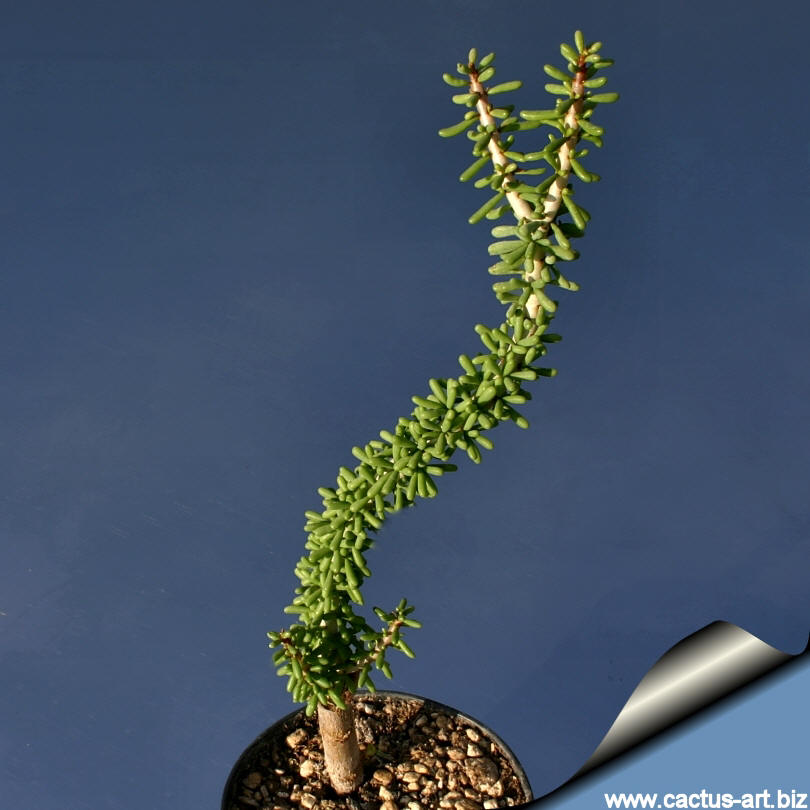
Ceraria namaquensis is a wonderful shrub, with a few
branches, and many tiny ovoidal
leaves along its stems. Interesting for bonsai work, and relatively easy
to grow, but very slow.
It is usually grown grafted on Portulacaria afra
|
|
Description: Very slow
growing smallish, woody stemmed desert shrub, 1.3 to 1.8 m tall high,
with many short, spiky semi-deciduous, succulent leaves.
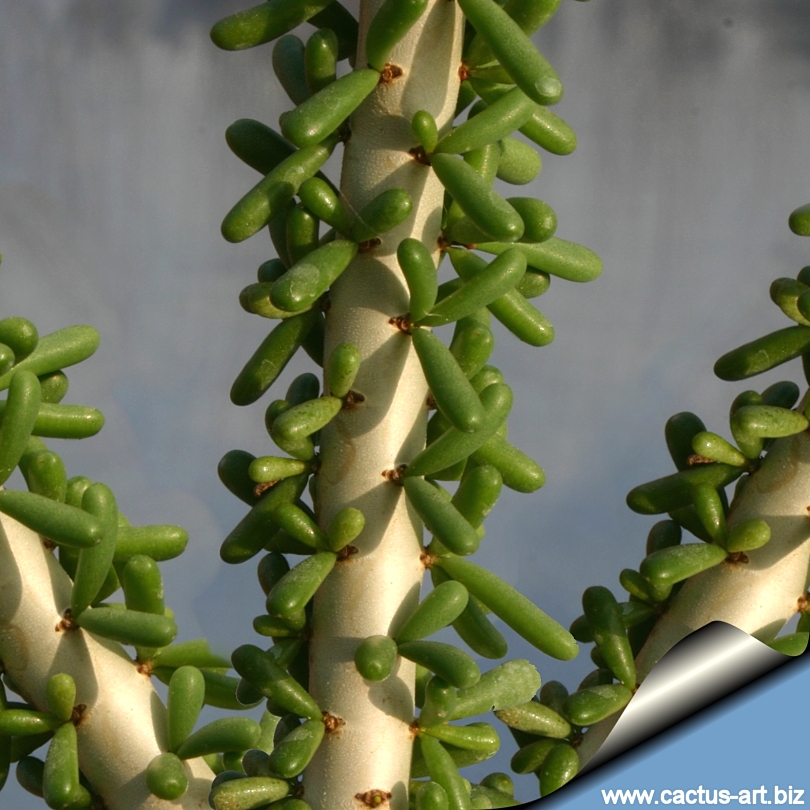
Stems: Branches are pale-barked (whitish or greyish-green), smooth
with a papery cortex and
dichotomous, the ultimate as thick as a goose-quill.
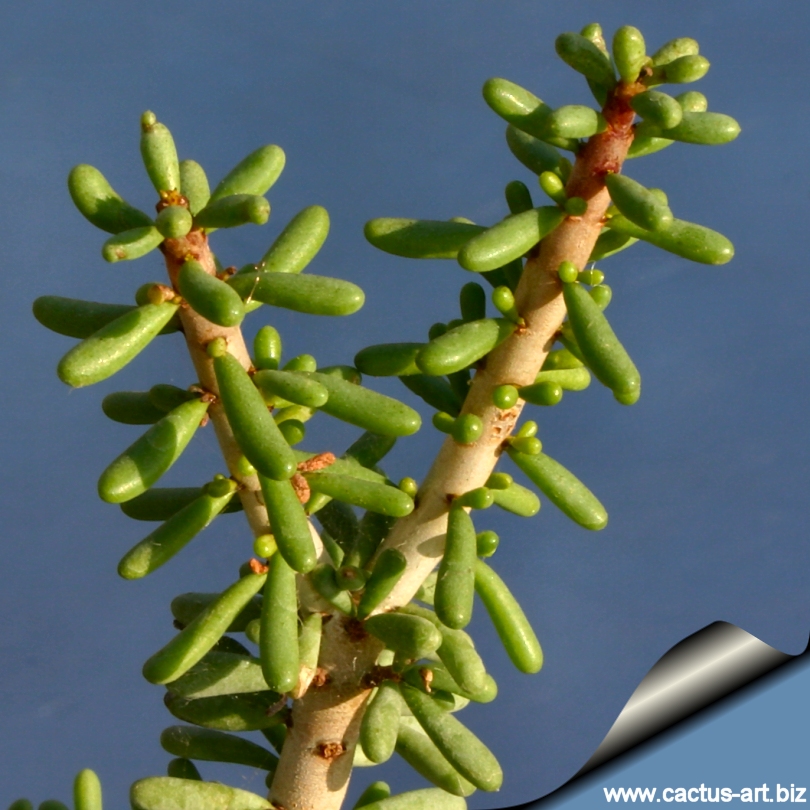
Leaves:
Ovoid green or grey-green 4 to 8 mm long, minute,
sessile. The leaves are produced on short shoots (brachyblasts).
The Ceraria loses its leaves during the summer drought in the
wild but in cultivation seems to retain its leaves year round, and a
certain degree of growth.
Flowers: Peduncles 13-17 mm long, angular, unbranched. Pedicels
involucrated by some minute ovate bracts, about 4 mm long, solitary or
few. Calyx 2-phyllous, three times shorter than the 5 rose-colored,
obovate, near 2 mm long petals. Stamens 5; filaments linear. Anthers
oblong, emarginate at both ends. Ovary ovate. Style short.
Cultivation: It is usually grown grafted on Portulacaria afra.
This species is of easy cultivation but very slow growing and seems to
want to grow all the year round in the greenhouse. Seedlings and rooted
cuttings are more sensitive and cannot tolerate stagnant water around
their roots (especially in winter) as this species comes from very dry
areas. Keep warm in winter.
Propagation: Seeds, cuttings or (usually) grafting.
It is said many times that C. namaquensis is impossible to root
and so it is usually grafted on to stems of Portulacaria afra.
Furthermore is very easy to graft it onto the Portulacaria and
the two plants grow very well when grafted.
But despite that, cuttings taken in summer
have proved to be able to root
in commercial peat blocks (often used for rooting more difficult items
such as rarer euphorbias, Madagascan thorn bushes and stems of
Pachypodium succulentum). A good percentage of cuttings survive well in
the moist peat blocks and after about three months begin to root and
grow. P. afra and C. namaquensis (the wolftoon) are the
only members of the family which grow to tree size.


|


 Cultivation
and Mail Sale
Cultivation
and Mail Sale