|
|

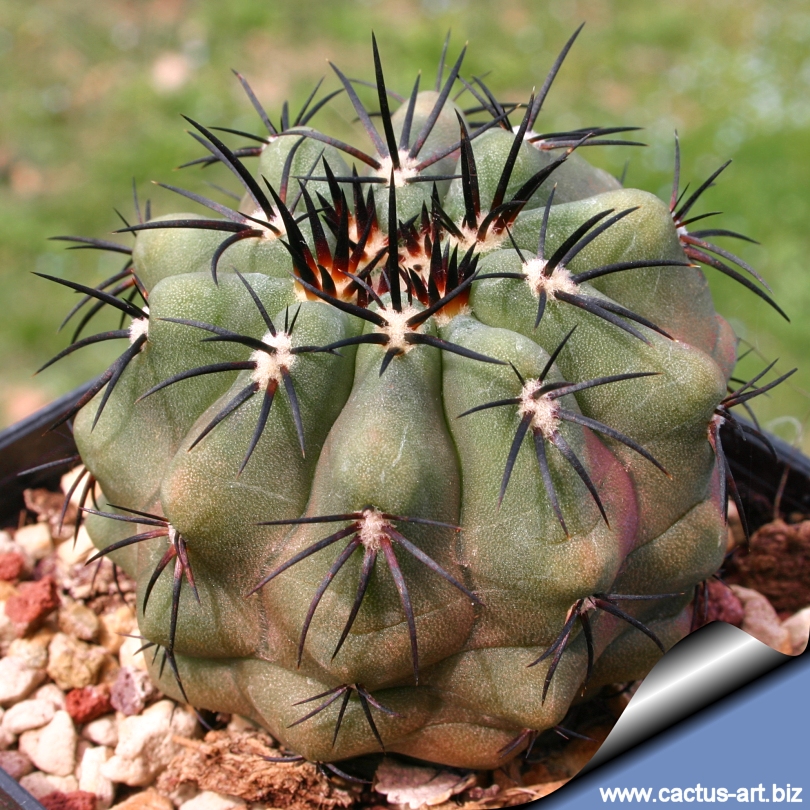
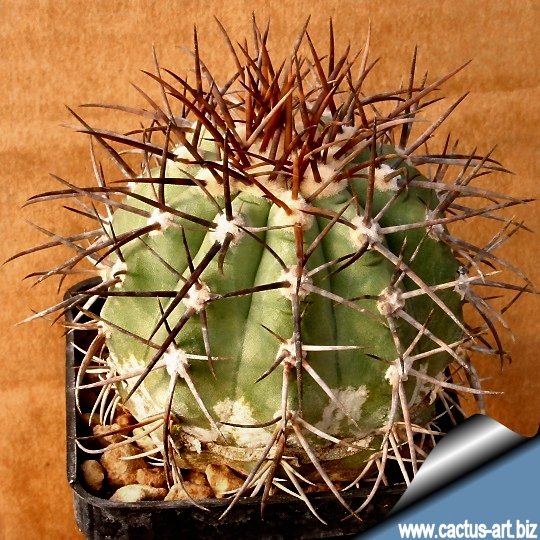
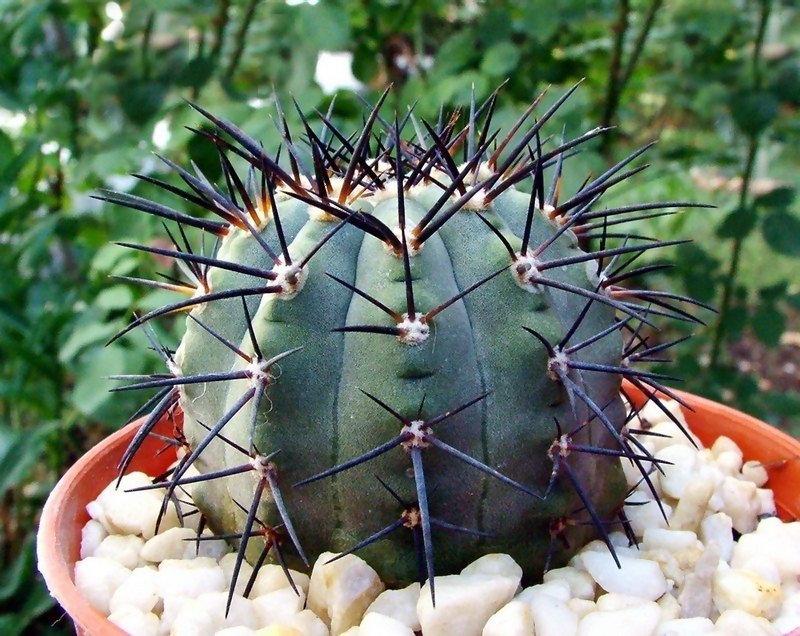
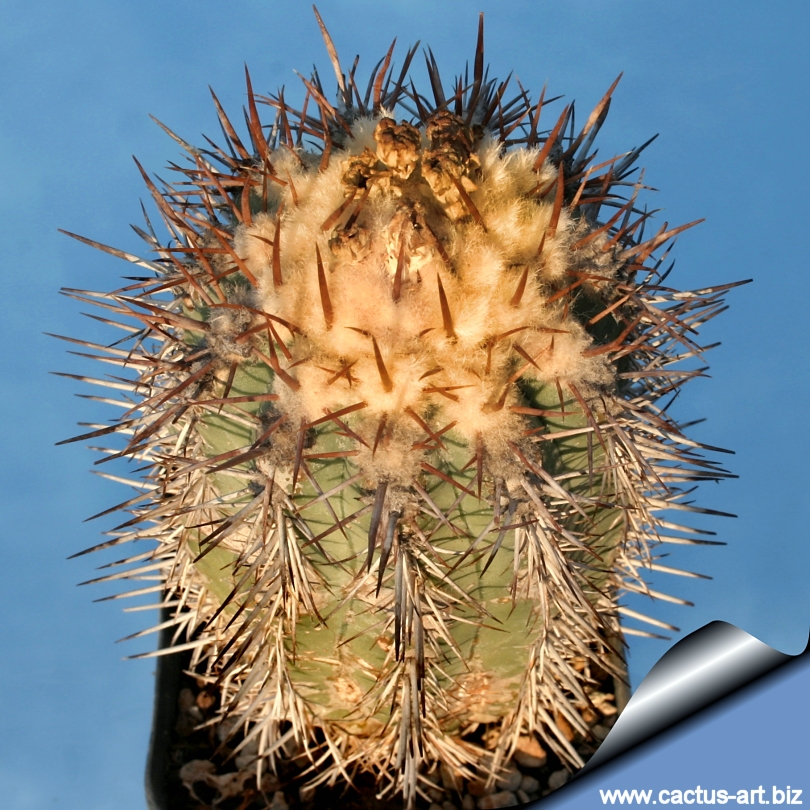
Copiapoa calderana.
Really magnificent!!!
|
Description: Usually
solitary or slowly clumping columnar cactus.
Stem: Dull greenish or greyish-green, not pruinose, depressed
spherical or cylindrical, 15(-30) cm tall, 10 cm in diameter; Apex
densely woolly.
Ribs: 10 to 17.
Areoles: Yellowish-grey, later black, 5 mm across.
Spines: Thick reddish brown to black.
Central spines: 1( to 2), 2.2 to 3 cm long.
Radial spines: 5 to 7, 1.3 to 1.5 cm long.
Roots: Long tuberous.
Flowers: Large light yellow funnel-shaped, 3 to 3.5 cm in length,
3 cm wide, scented.
Blooming season: Spring and summer,
Fruit: Pale green, reddish above to 15 mm long.
Seeds: Glossy black
Note: This appears to be a very variable species.
|
 |
 |
|
Plants at different stages of development. |
|

Photo &
© copyright by
Süleyman Demir Turkey
Home page:
http://community.webshots.com/user/demir165 |
 |
|
Cultivation: This slow growing cactus is kept for the beauty of
its form. It must be protected from excessive heat and sun in summer,
and seems to do best in cultivation with a bit of shade. It requires
light but regular waterings in summer, but let the soil mix dry between
waterings, Prone to rot if over-watered. Needs good drainage. Keep
warm and dry in winter (10°C) to avoid rot. Not highly tolerant of a
great deal of frost. (Frost tolerance 0°C)
Propagation: Seeds (or offsets if available), Grafting is often used
to speed growth rate and to create a back-up to plants in collection.
|
|


Advertising
|
|
|
|
|
Family:
Cactaceae (Cactus
Family)
Scientific name:
Copiapoa calderana F.
Ritter
Origin: Coastal deserts of northern Chile, Antofagasta,
North of Caldera (3ª region of Copiapó)
Habitat:
These plants live in the
mainly in the generally rocky coastal areas. The long tuberous root of
this copiapoa is buried deeply in these soils which are very poor in
organic matter. The superficial layer is completely composed of "maicillo"
(granite) and in the deepest levels are very dense clays which are able
to retain some water throughout the summer. In the area where this
plants grows there is very little rain but frequent coastal fog, which
provides a significant part of their water needs.
Conservation status: Listed in
CITES appendix 2.
Etymology:
Copiapoa is named after the city
of Copiapó in northern Chile. 'Calderana' refers to Caldera, another
location in Chile.
Synonyms:
- Copiapoa atacamensis
- Copiapoa lembckei Backeberg 1959
- Copiapoa calderana var. spinisor
F. Ritter 1980
- Copiapoa marginata (Sd) Br&R
- Copiapoa magnifica
- Copiapoa marginata v. magnifica
- Copiapoa streptocaulon
- Copiapoa boliviana,
- Echinocactus bolivianus
Copiapoa calderana is
a highly variable taxon with several more or less similar forms that
could be described as local varieties as demonstrated by the
number of varieties and their synonyms. Some authors
suggest that this is a complex species or species aggregate. The several
classifications and reclassifications provide evidence of the confusion
that rules regarding the names used. It
seems that many botanists and hobbyists who have studied Copiapoa in
habitat have formed their own concepts of which names should be applied
to which plants. It is relatively easy to attribute some key features
that dominate in certain populations, but it is equally possible to look
more closely at plants in these populations, and find individuals that
'break the rules' and would easily fit another population's dominant
characteristics.
|
|
|
|


This species has large whitish-grey woolly areoles & stout spines,
spines colour vary from reddish to black.
Photo of
conspecific taxa, varieties, forms and cultivars of
plants belonging to the
Copiapoa calderana
complex.
(This
Taxon has lots of synonyms (like many other Copiapoa) with several
controversial varieties and subspecies, and comprises several different
forms, but where each form is linked to others by populations of plants
with intermediate characteristics):
|
|


 Cultivation
and Mail Sale
Cultivation
and Mail Sale