|
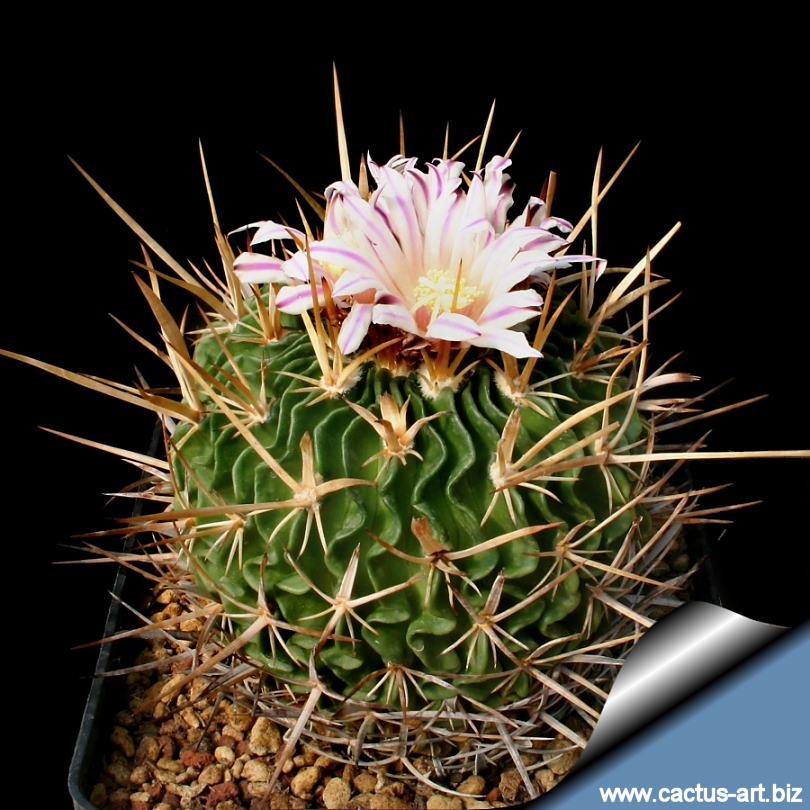
Description: This plant is
characterized by large, wide and flat central spines.
Stem: Ovoid to oblong ca. 12 cm tall, 10 cm in diameter, brightly
bluish-green.
Ribs: 14-22 (or more: to 30)
Radial spines: 4-6 on the lower par of the areole, straight,
glassy, 8-12 mm long, and 3 reddish-grey in the upper part of areole of
which the central one is flat-pressed directed upward up to 3 cm long
the lateral are shorter.
Central spine: 1 Horn coloured right-angled, with dark tip, longer and more
rigid, directed upward up to 4 cm long,
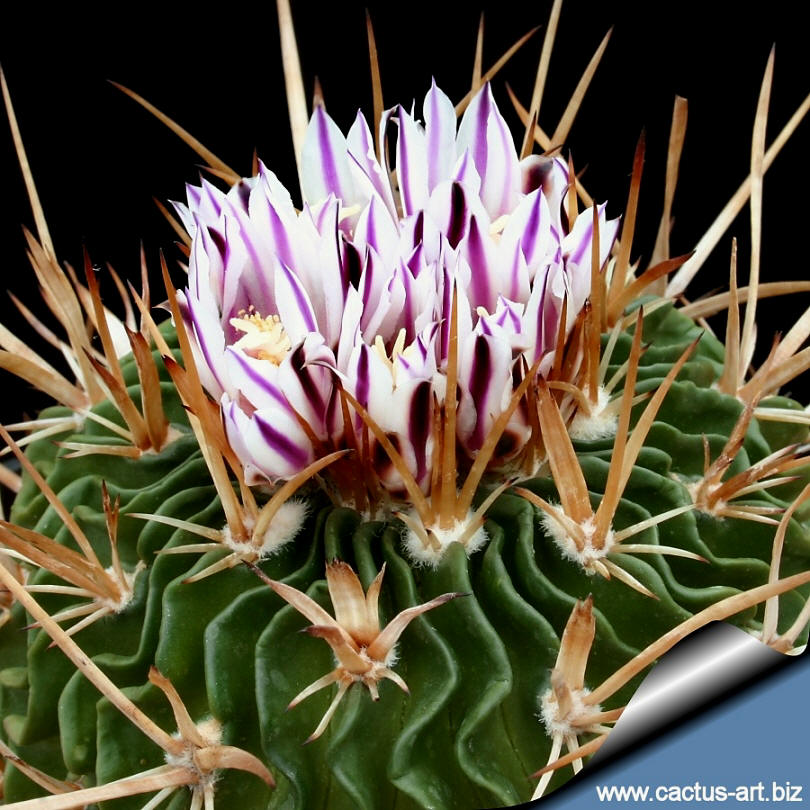
Flowers: White with carmine- red central strip (or yellowish?),
about 2 cm long and wide.
NOTE: Plant with wide flat central spines labelled E.
gladiatus are frequently seen in cultivation and in nurseries
catalogues, but the descriptions of this species by individual authors
are so different, that it is doubtful, if this name is correct. E.
gladiatus is in fact very similar (if not the same) to E.
crispatus and particularly to E. violaciflorus, but this
description fit also for E. lamellosus. Identifying the species
of an Echinofossulocactus is as difficult as identifying the genus is
easy. For the most part, they tend to look alike, and there are far more
names than there are species.
Photo of
conspecific taxa, varieties, forms and cultivars of
plants belonging to the
echinofossulocactus crispatus
complex
(This
Taxon has lots of
synonyms (like most Echinofossulocactus) whit several controversial
varieties and subspecies):
|


 Cultivation and
Mail Sale
Cultivation and
Mail Sale