|
Description: F.
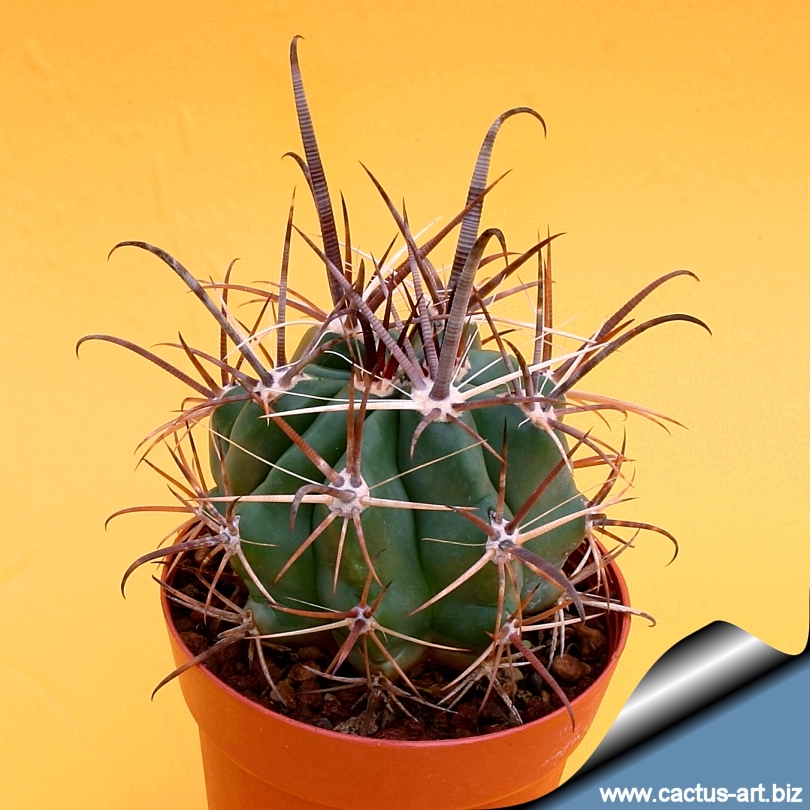
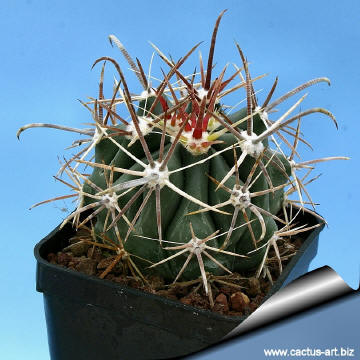
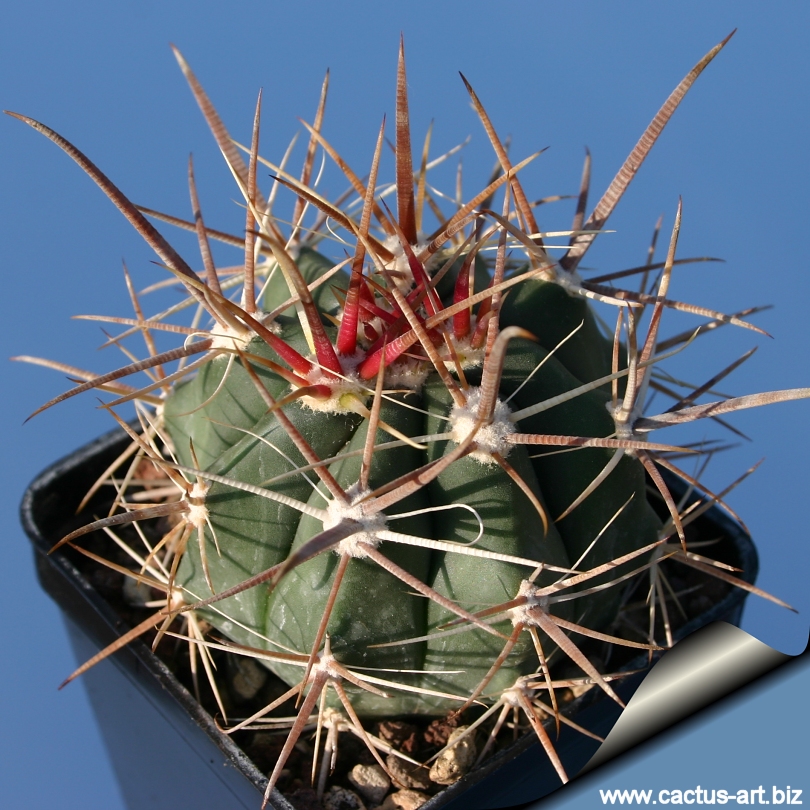
santa-maria is a massively spined barrel cactus, usually solitary. It is
a close relative of Ferocactus peninsulae.
Stem: Spherical to shortly columnar, up to 75 cm high, and 25 cm
wide.
Ribs: About 13, blunted, straight.
Areoles: Large, oval, 2 cm long and 12 mm wide, with yellow-brown
felt.
Central spines: 4, quite straight and hooked up to 4.5 cm long,
the lower three (middle) are the longest, flattened, sometimes curved at
the apex..
Radial spines: About 15, the upper 12 bristle-like, light colored,
the lower 3 look like the middle ones, and
are often counted along with them, in
which case the central spines are 7 and the radial 12
Areolar glands: They are found between the flower’s bud and the
spine cluster in the flowering areoles.
Flower: 3.5 to 6 cm long and 4 to 7 cm wide, yellow or straw-yellow with
a pale-red center line on the petals, pleasant-smelling.
Blooming season: August-September.
Fruit: Yellow or yellowish green, fleshy,
2 to 5 cm long and 2 to 3,5 cm wide, with lasting Perianth. Fruit wall
approx.. 3 mm thick, pulp extraordinarily juicy, at the beginning
slimily, glassily, with fruity taste soon drying, fruit then opening by
a basal pore.
Seed: dark-brown or black, 2-2.5 mm long and 1.5 mm wide; Testa
with a fine polygonal network;
Hilum small, approximately 0,5 mm in diameter.
|


 Cultivation
and Mail Sale
Cultivation
and Mail Sale