|
|
|
Photo
and © copyright by
Andrea
B. (Bologna, Italy)
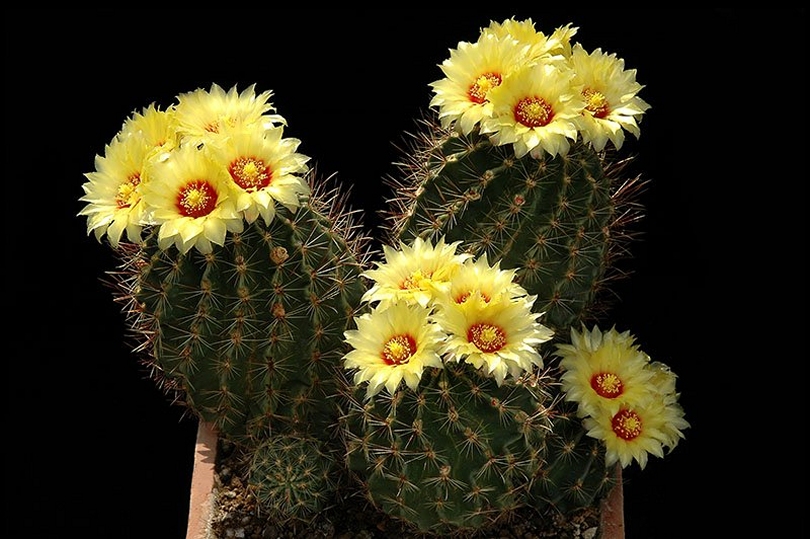
A succession of large silky
yellow flowers in summer.
|
|
Description:
Habit: H.
setispinus is a typically
solitary
cactus that sometime will
offsets from it’s base. This species produces a lot of fragrant
yellow, orange-eyed flowers at the top of the stem. An attractive
blooming machine.
Stem:
Globular
to cylindrical,
yellow-green to dark bluish green of flabby texture like
Echinocereus,
up to 15 cm tall, 10 cm in diameter; distinctly ribbed.
Ribs: About 13
high and 1-2 mm wide, very evident, thin,
wavy on the margin, straight or more or less spiralled.
Roots:
Long fibrous.
Areoles : ±
circular, 5-8(-14) mm long, 2-7 mm wide, 15 mm apart, with short
wool and finally naked: Areoles typically bear extrafloral nectaries.
Spines:
Both radials and centrals, white
or yellowish and brown
radials 12 to 16 (10-30 mm long),
central 1 to 3 one of them usually
hooked, longer than the radials, 6 to 40 mm long (or more).
Tubercles absent.
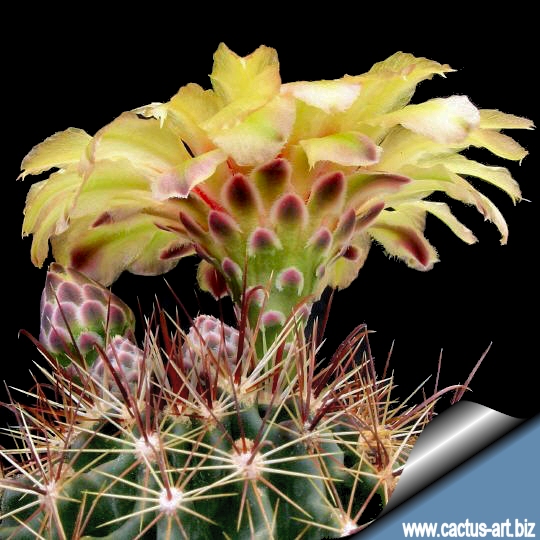
Flower: Silky
yellow with orange to darker red
throat , 3 - 7 cm across, 3,8 - 5,2(7) cm long. Inner perianth
segments oblong, acute, widely spreading. Flowers-bud pointed, covered
with imbricated naked scales (whithout wool or bristles in the axil).
Flower-tube narrow, funnelform.
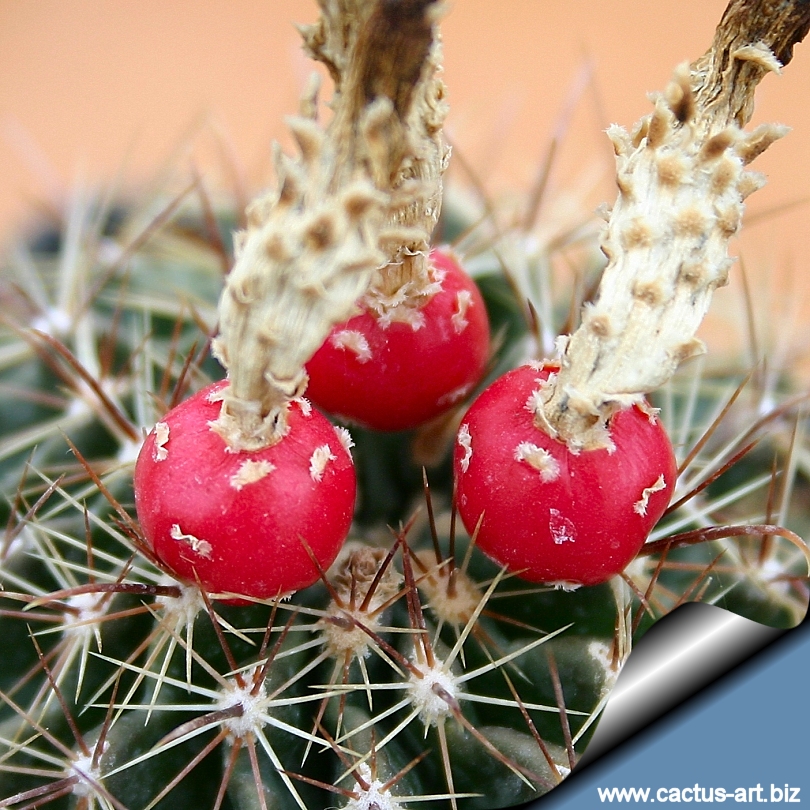
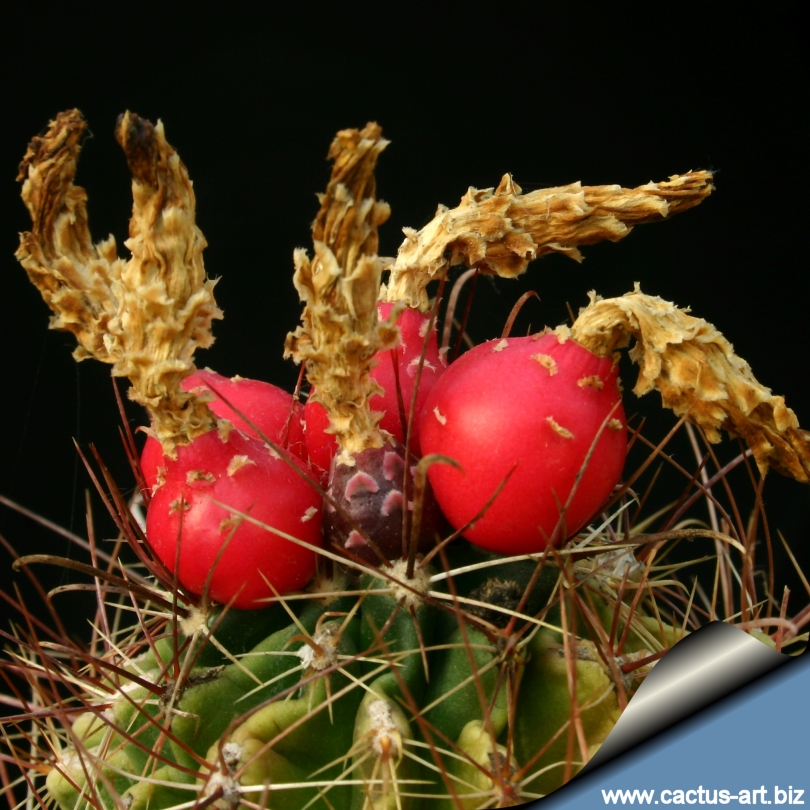
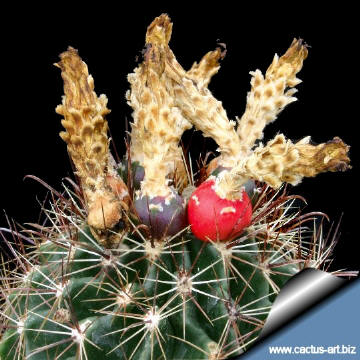
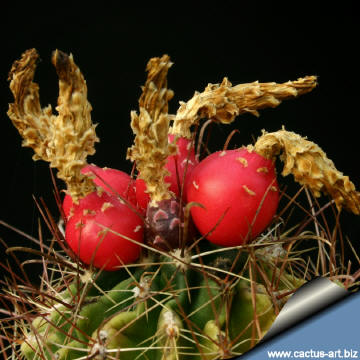
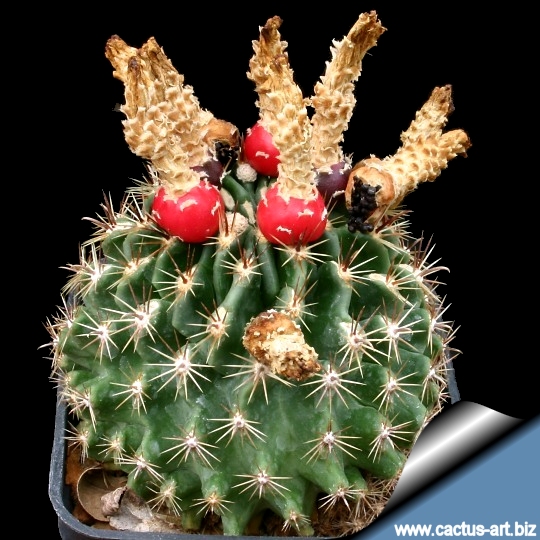
Fruit: Red and
fleshy, nearly naked,
globular to
ovate, 8-11 mm long, that
dry and
fracture
basally at full
maturity.
Seeds: 1,3-1,7 mm
long and 0,5 -0,8 mm diameter, black tuberculate, hilum large basal,
circular.
Phenology: Summer
grower.
Blossoming time:
It flowers very well, even when quite young, producing lots flowers in
succession all
Summer.
In
the past several forms with different spine and stem size, flowers and
fruit colour have been described and some authors gave them a variety
name, however they grows at the same locality and under the same
condition, so nowadays all them are considered part of a polymorphic
species. For example:
H. setispinus hamatus With long hooked central spines.
H. setispinus hamatus fa. flavibaccatus whith yellow
fruits.
H. setispinus setaceus With very thin spines.
H. setispinus brevispinus With very short central spines.
etc...
|
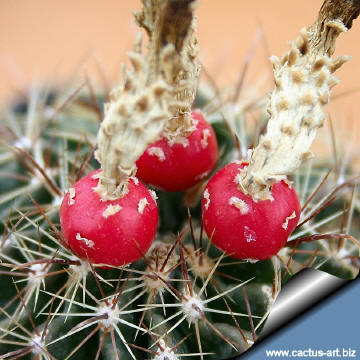
Fruits with persisting flowers remnants. |
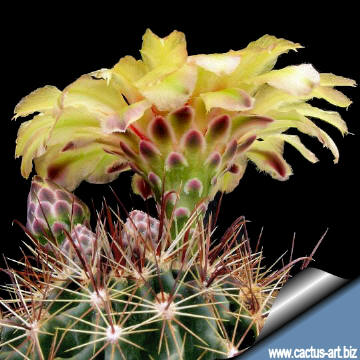
Buds and
floral tube are
scaly. |
 |
 |
|
Cultivation: This species is easy
and well worth growing, wonderful when grown in
containers as a patio plant in colder climates. Require little care once they have reached a
nice flowering size H. setispinus is suited for any
rich, well drained soil in full sun throughout the year (But do
better with some light shade in summer). Pot culture: grow best in a
well-drained container filled with a porous cactus soil mixture that
doesn't contain too much humus. To insure robust plants water and
fertilize during the aestival growth cycle, this plant need plenty
of water (indicatively to about once a week) But needs to be avoided
wetting the bodies of these plants while they are in sunlight. A wet
cactus in the sun light can cause sun burning which can lead to
scars or even fungal infections and death. Care must be taken to
prevent sooty
mould forming on the
sugary
secretions from near the
areoles.
Frost Tolerance: In winter keep completely
dry at 5°C this usually aids in maintaining a healthier plant, but
it is hardy as less as -12 to -7°C
depending on the
origin. (Temperature
Zone: USDA 9-11)
Reproduction: Seeds or cutting. Seeds are the typical way of
reproducing. These cacti will easily grow from seeds and some from
cuttings. Seeds can be sown in the spring or summer in well-drained
pots of cactus soil; sow the seeds thinly on top. Cover them with a
bit of fine quartz grit. Moisten and lay a piece of glass across the
top. The pots should be set in a warm greenhouse until they start to
sprout, after which the glass should be progressively removed so
they can receive full light and air. It isn't good to keep the
glass over the seedlings. Well-developed seedlings can be planted
separately in small pots.
Cuttings made from pieces of the stem of any size can be detached
and laid aside for a few days, to allow a protective "skin" to form
over the cut. They can then be planted in pots. Place them in a spot
where they'll receive sun, and do not water until the soil becomes
fairly dry. After a while the soil should be moistened regularly,
but never kept constantly saturated.
|
|
Photo of conspecific taxa, varieties,
forms and cultivars of Hamatocactus setispinus:
Advertising
|
|
|
|
|
Family:
Cactaceae
(Cactus
Family) Accepted
Scientific Name: Hamatocactus setispinus (Engel.)
Brit. & Rose
Published in: Britton & Rose, The Cactaceae; descriptions and
illustrations of plants of the cactus family 3: 104-106, f. 110, 111,
112, 113, 114, 1922
Conservation status: Listed in
CITES Appendix II
Distribution: USA (Southern-Texas) and Northern Mexico (Taumaulipas
; Nuevo Leon, Coahuila)
Habitat: It is often found growing under Mesquite scrubs on
costal lowlands. Altitude 0 – 550 m
Etymology:
The
genus name "
Hamatocactus"
derives from the Latin word “Hamatus” meaning “fish-hook”
to describe its central spines furnished of a terminal hook and the word
"cactus", the genus from which this
segregate
was removed. ( The genus name implies:
"hooked
cactus").
The
species name "setispinus"
Derives from the Latin name “seta” meaning “bristle”
or “stiff hair of an animal” + “i” (connective
vowel used by botanical Latin) + “spina” meaning “thorn,
prickle, spine” + “us” (latinizing suffix) ( The specific
name implies:
"
bristle-like spines ").
Synonyms:
-
Echinocactus setispinus
hamatus
(Muehlenpf.)Engelmann
In: Bost. Journ. Nat. Hist. 6:
201. 1850
- Thelocactus
setispinus (Engelm.) E.F.Anderson
- Ferocactus
setispinus (Engelmann) L.D.Benson (1969)
- Echinocactus
setispinus Engelmann
In: Bost. Journal. Nat. Hist.
5:246. 1845
- Echinocactus
setispinus setaceus
Engelmann
In: Bost. Journal. Nat. Hist.
6:201. 1850
- Echinocactus
muehlenpfordtii Fennel
In: Allg.Gartenz. 15:65. 1847
- Echinocactus hamatus
Mühlenpfordt
In: In:
Allg.Gartenz. 16:18. 1848 Not Forbes 1837
- Echinocactus
setispinus cachetianus
Labouret
In: Monogr. Cact. 203. 1853.
- Echinocactus
setispinus v. mierensis
K. Schum. (1898)
- Echinocactus
setispinus v. setaceus
Engelm. (1850)
- Echinocactus
hamulosus Regel
In: Ind. Sem. Hort. Petrop.
34. 1856
- Echinopsis nodosa
Linke
In: Wochenschr. Garten. Pflanz.
1:85. 1858
- Echinocactus nodosus
Hemsley
In: Biol. Center. Ameri. Bot.
1:535. 1880
- Echinocactus
setispinus muehlenpfordtii
Coulter
In: Contr. U.S. Nat. Herb.
3:370. 1896
- Echinocactus
setispinus mierensis
Schumann
In: Gesamtb. Kakteen 340. 1898
- Echinocactus
setispinus orcuttii Schumann
In: Gesamtb. Kakteen 340. 1898
- Thelocactus
setispinus v. mierensis (K. Schum.) Pilbeam (1996)
|
|
|
|
|
|
This plant, like the
Ferocacti (within which genera some botanists place this plant, whilst
some others prefer Thelocactus), has
areolar glands that produce
nectar
.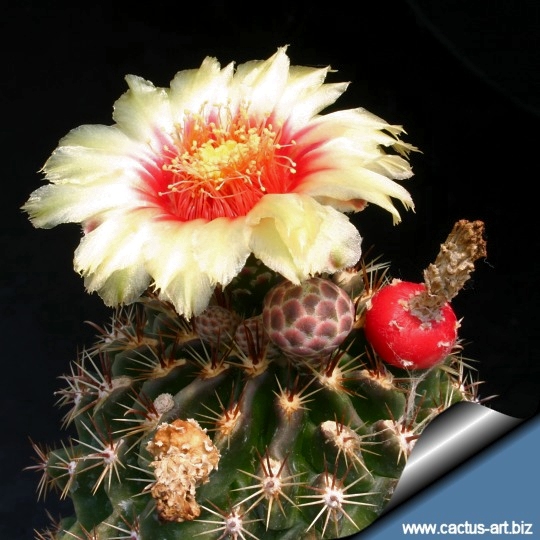
The satiny yellow
flowers have a contrasting red
throats.
|
|

 |
|


 Cultivation and Mail Sale