|
|
|
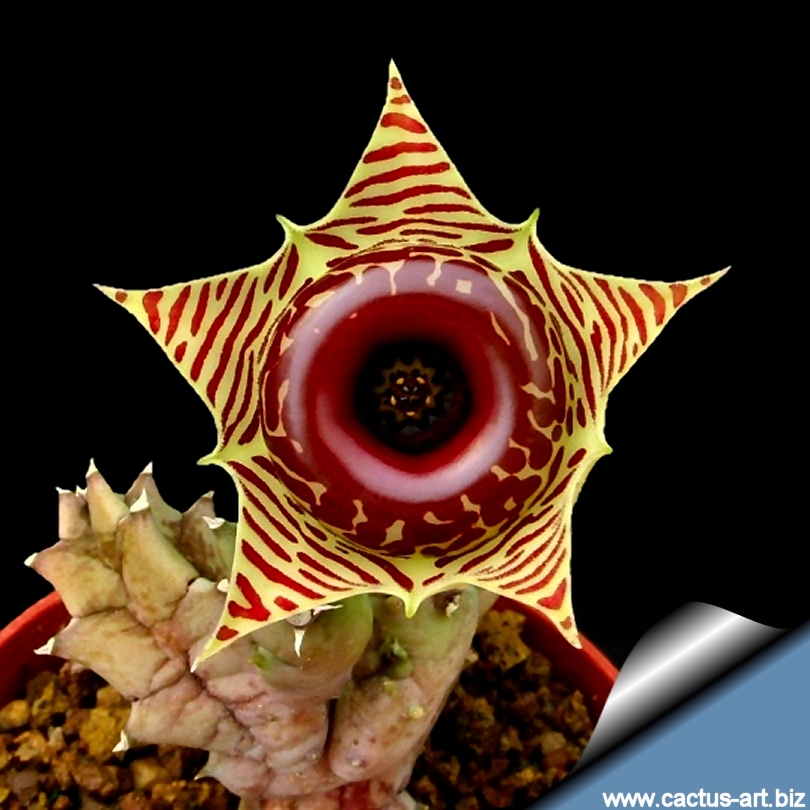
Shiny, large flowers may look like plastic, but it's
for real. |
|
Advertising
|
|
|
|
|
Family:
Asclepiadaceae
(Apocynaceae) (Milkweeds family)
Scientific name: Huernia zebrina ssp. magniflora
(Phillips) L.C. Leach
In: Excelsa, Taxon. Ser., 4: 139: 1988
Origin: H.zebrina
has a wide distribution being found in Namibia, Botswana, Zimbabwe,
Mozambique, Swaziland, and the Mpumalanga, KwaZulu-Natal and Northern
Provinces of South Africa. The
ssp magniflora differs from
ssp zebrina in having stronger, more robust
stems and, as the name suggests larger
flowers and grows throughout in the lowlands of south-east.
|
Description: It is one of the most beautifully flowering huernias.
The
flower is anything up to 8.5 cm (usually 6- 7cm) in diameter,
star-shaped, whitish or yellowish with red or purplish spots and
lines. In the middle of
corolla there is a vivid
annulus, on which spots often merge into a unique
pattern. They are also very shiny and may look like plastic, but
it's for real. Only the magniflora form of
Huernia zebrina looks similar and is easily recognisable.
Flowers are also quite variable both in colour and markings.
Forms
clumps with
stems being
toothed about 2 cm in diameter.
|
|
|
|
Cultivation: Huernia zebrina isn't difficult
to grow and flower. Both
subspecies require a very
draining
substrate with a big portion of sharp
sand or
perlite or
pumice. They need winter temperature over 10 °C and they need very
careful
watering during warm days. As with other stapeliads, the most
dangerous
diseases and
pests are
black rot and
mealy bugs. The easiest way of
propagation is by rooting
stem cuttings or by
sowing, if seeds are available.
Half shade in
Summer.

 |
|


 Cultivation and Mail Sale