|
|
|
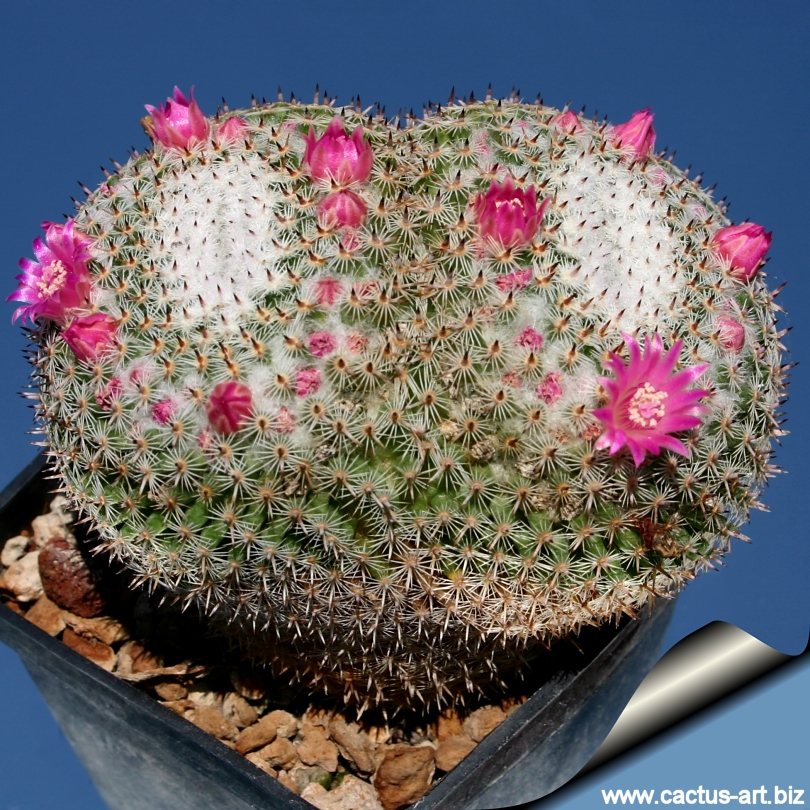
After
several years
the old plants divide at their apex, ramifying dichotomously (to
form two or more distinct joints) and in 10 years they
forms small colony.
It is a pleasing
sight, even in the depths of winter.
|
|
 |
 |
|
.
|
|
 |
 |
|
.
|
|
 |
 |
|
.
|
|
 |
 |
|
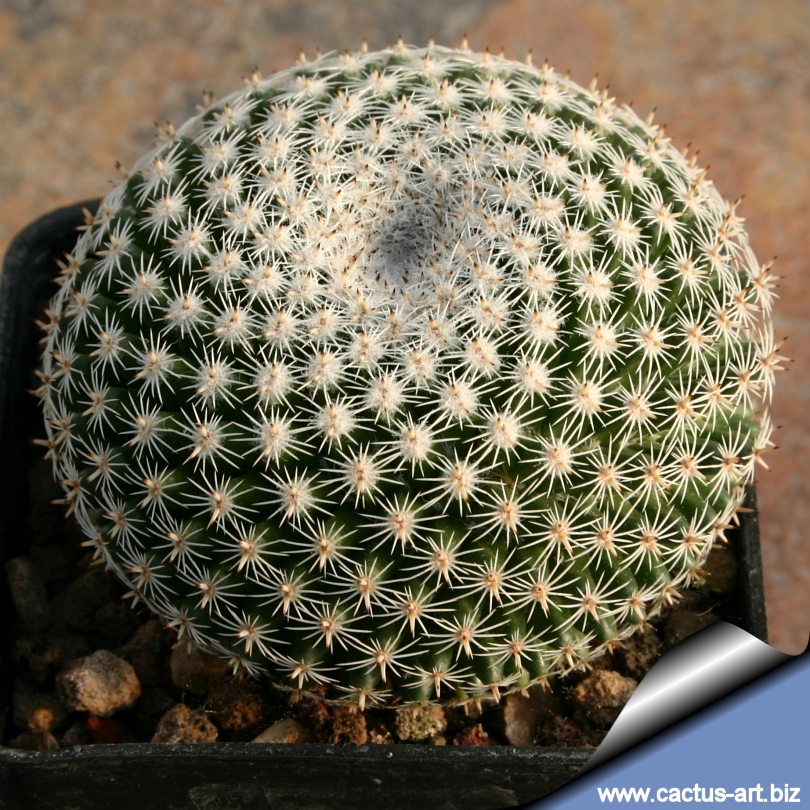
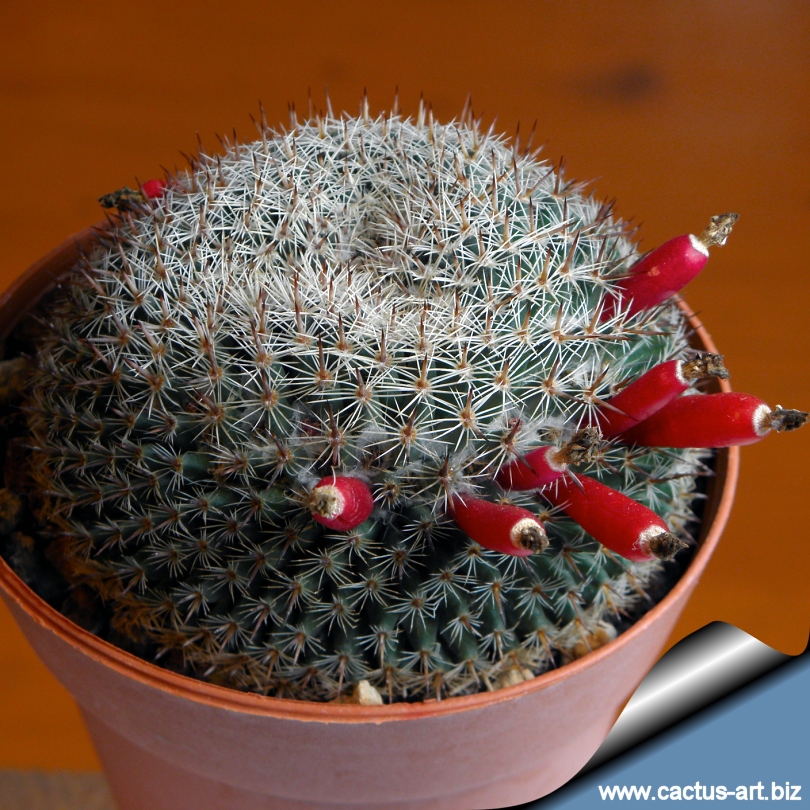
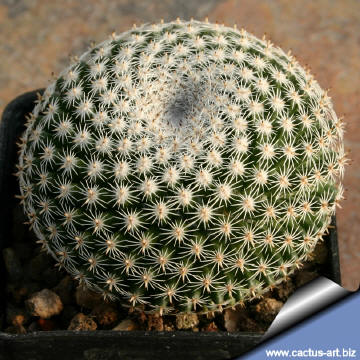
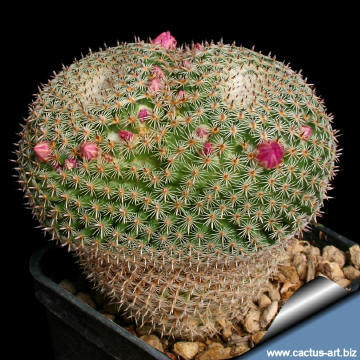
Its symmetrical globose body is largely obscured
by the fairly numerous interlacing white radial spines, against which
the two short black centrals stand out. |
|
Advertising
|
|
|
|
|
Family:
Cactaceae (Cactus
Family)
Scientific Name:
Mammillaria perbella Hildmann
ex K. Schumann - Published in: Gesamtbeschr. Kakt.
567. 1898 (as Mamillaria)
Origin: Central Mexico (This species has a fairly
large area of distribution in Mexico: from the state of Querétaro across
central Mexico to the state of Oaxaca on the Pacific coast. )
Habitat: Between rocks in humus soil on the limestone slopes.
Altitude 1500-2800 m.
Conservation status: Listed in
CITES appendix 2.
Synonyms:
- Mammillaria pseudoperbella
First description by Quehl; Monatschrift für kakteenkunde 19: 188,
(1909).
- Neomammillaria pseudoperbella (Quehl) Britt. & Rose
Cactaceae 4: 109. 1923.
- Mammillaria pseudoperbella rufispina Quehl
Monatsschr. Kakteenk. 26: 94. 1916.
- Mammillaria perbella fma. pseudoperbella
- Mammillaria
cadereytensis R. T. Craig 1945
- Mammillaria infernillensis R. T.
Craig 1945
- Mammillaria queretarica R. T.
Craig 1945
- Mammillaria avila-camachoi Shurly
1961
- Mammillaria vonwyssiana
Krainz 1945 a
Related to
Mammillaria microthele.
Mammillaria aljibensis
is probably a synonym.
|
|
|
|
Description: Simple or dichotomicously branched (occasionally
ramifies , producing a few basal shoots) with short dense spines.
Stem: Symmetrically globose at first, later cylindric, with a
depressed apex that appears completely white. 50 - 200 mm high and 50 -
80 mm in diameter, dull green and may, with age, become suberized at its
base.
Tubercles: Short cylindric/conical firm, 6 - 7 mm long and 2 mm
wide, arranged in numerous, very close-set spirals. The Axil is naked or
with a little bit wool and bristles.
Roots: Fibrous.
Radial spine: 20 - 30, short, 1 - 3 mm long, somewhat
horizontal radiating and arranged laterally on each side of the
tubercle, white.
Central spine: 0-1 or usually 2 (but some plant have 4),
divergent, one pointing upwards and often longer (up to 5 mm
long), the other turned backward, 1-3 mm long, awl-shaped, straight,
smooth, thicker at base, they are both brownish with a darker tip.
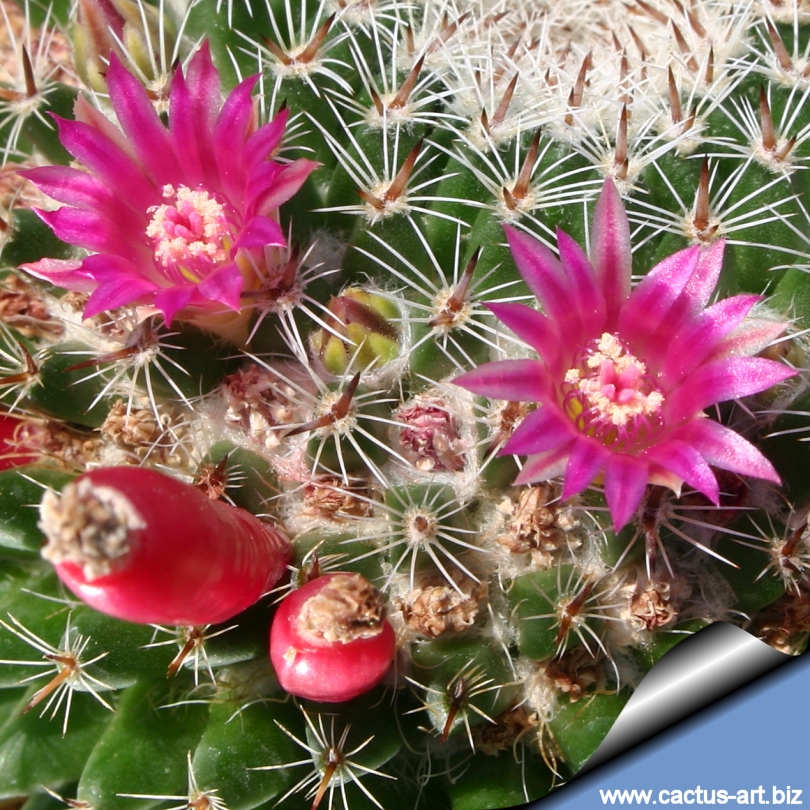
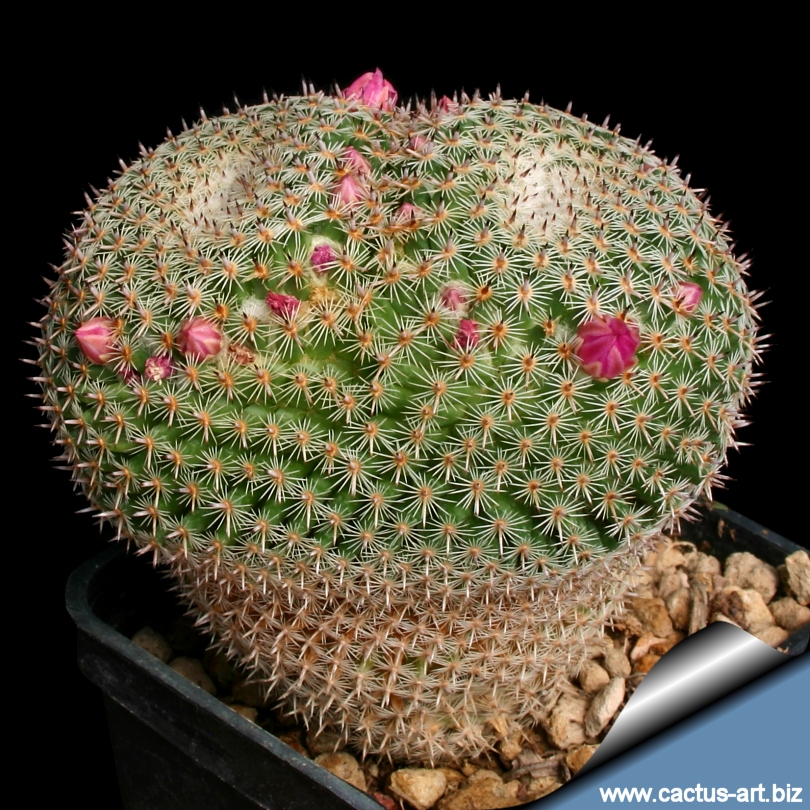
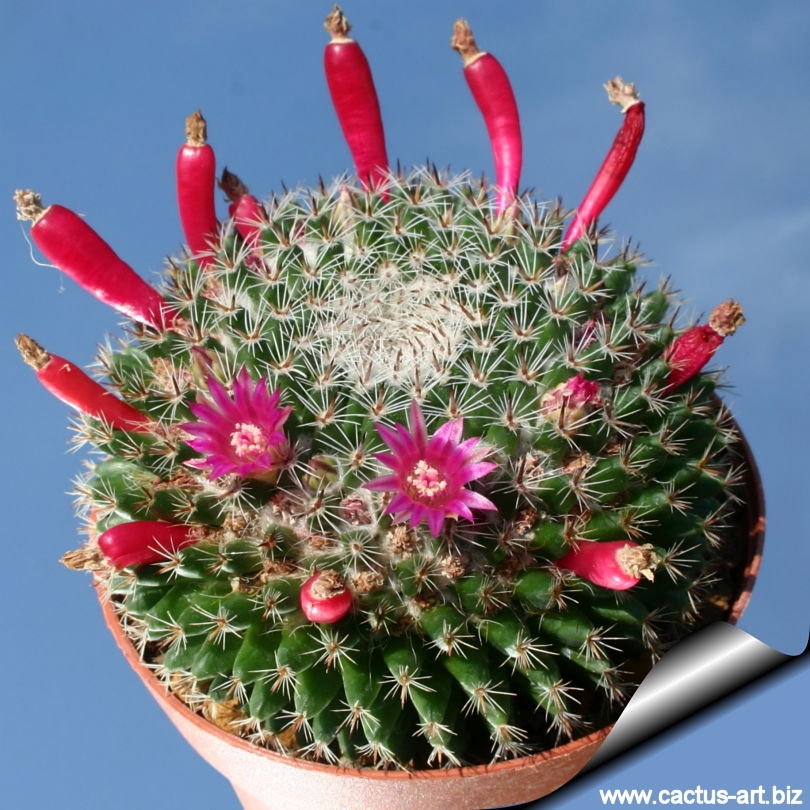
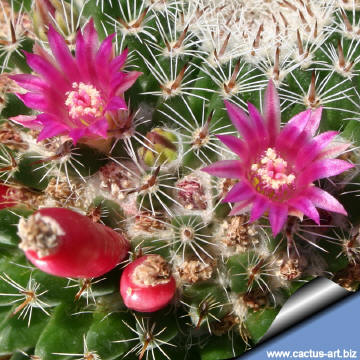
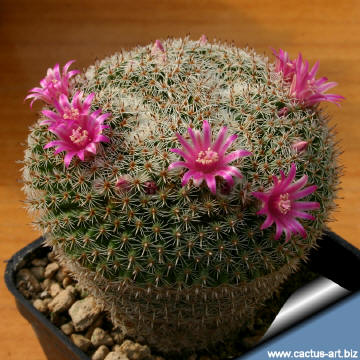
Flower: Small, funnelform, 10 - 12 mm long and in diameter,
purplish pink with darker midstripe. The perianth-segments are
narrow-oblong, with an ovate acute tip; the style is longer than the
filaments, pinkish; the stigma-lobes are 3, obtuse.
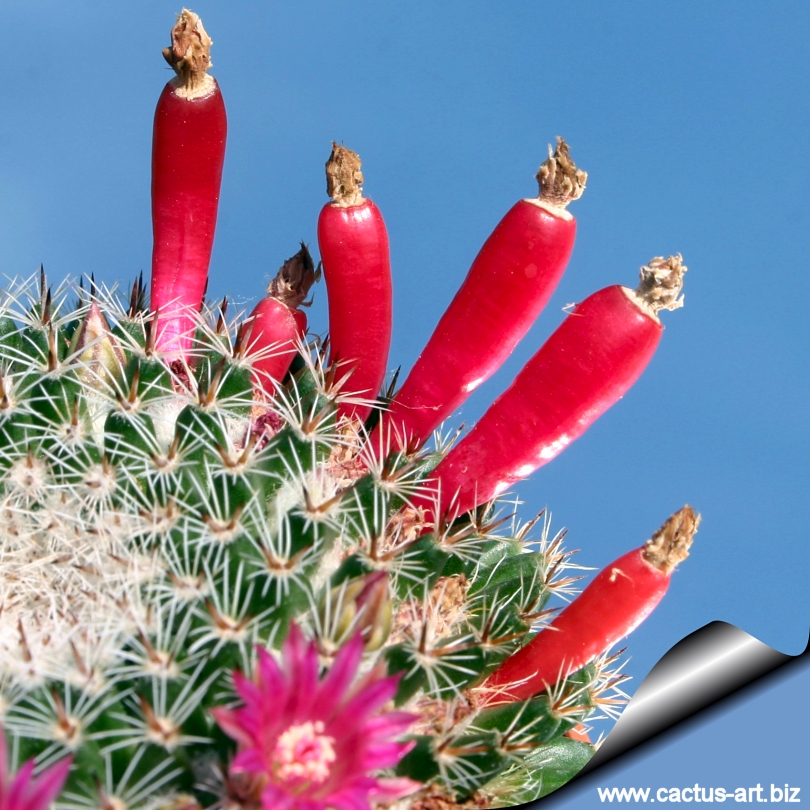
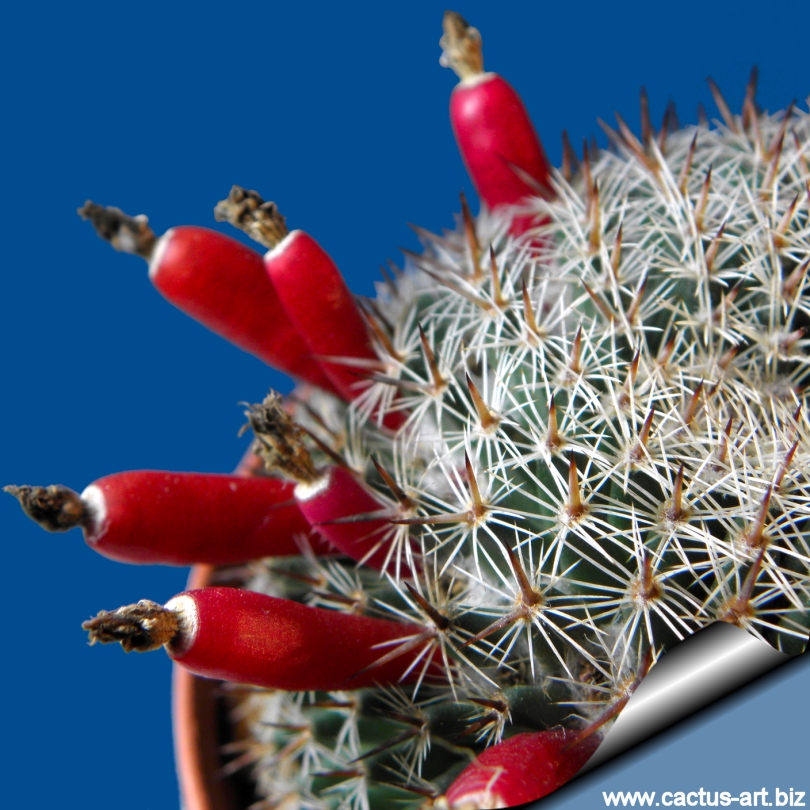
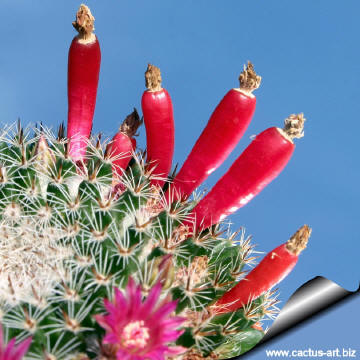
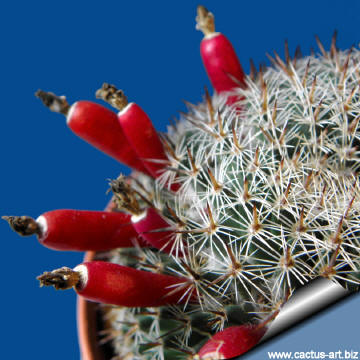
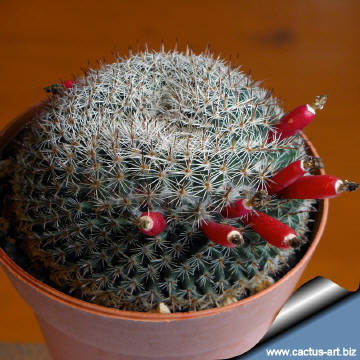
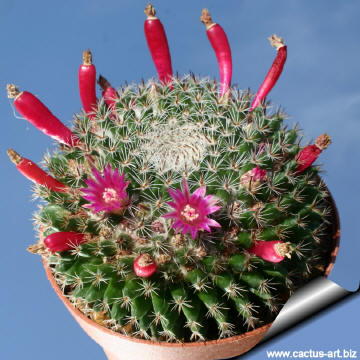
Fruit: Attractively deep dull pinkish-red coloured .Club-shaped,
10 - 15 mm long and 2 - 3 mm wide. Ripens 7 months after flowering.
Selfsterile.
Seed: Brown, club-shaped, 1 mm long and 0,8 mm wide. Hilum small
and sub-basal.
|
|
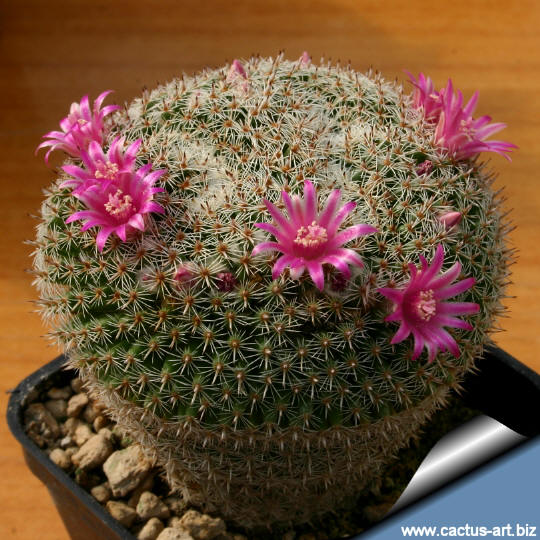
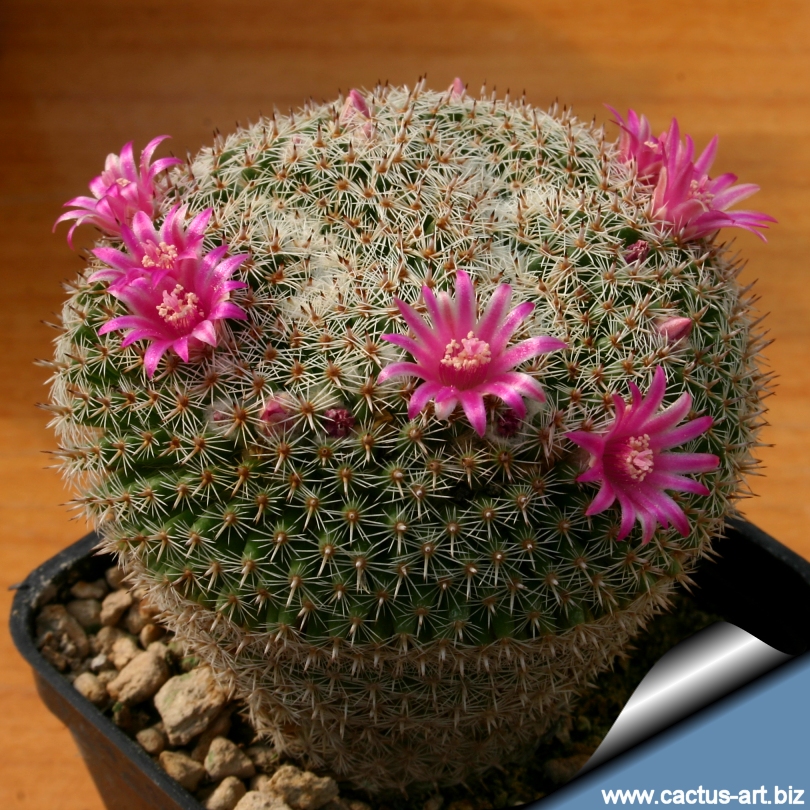
Spring to summer brings the purple-pink
flowers and it is then a joy to behold.
NOTE: There are actually in
cultivation several forms of this controversial species.
The one labelled M. pseudoperbella (=
Mammillaria perbella lanata?) have usually carmine pink flowers
with darker midstripe usually in several complete rings in April-may,
with 20-30 setaceous radial spines and abundant axillary wool, while the
one identified as M. perbella
have sparse purplish pink flowers opening most of the
summer with fewer stouter and shorter radial spines. But this division
is arbitrary and it is almost impossible to discern the two plant
and the many intermediate forms .
This is one of the Mammillaria
commonly called "Owl Eye Cactus", known for
dichotomous branching (forking or dividing into two parts). Although
dichotomous branching is not a common occurrence in cacti in general, it
happens for some reason in this particular subspecies. What
is interesting about this cactus is that it began as a single head, and
it has now divided twice, forming what will be four separate branches.
When the division process started, it was obvious that four heads would
appear, but I don’t think the one head divided quadruply. Most probably,
one head became two, and then those two immediately divided.
Other Owl Eye Cactus among others comprise:
M. karwnskiana,
M. formosa,
M. tlalocii and
M. microthele.
Cultivation:
This plant is easy to cultivate but very slow growing. Cultivate it in a
well
drained and
mineral substratum.
Water regularly, avoid
the use of
peat or other
humus sources in the
potting mixture. It need full sun, so it keep a compact and flat
shape. It does not tolerate intense cold, but tolerates
some cold if kept dry. Frequent transplantations of the young plants
protect the lower part of the stem from the lignification, to
which the plant has a tendency.
Reproduction: It is propagated by seed.
Sometimes old plants divide at their apex, ramifying dichotomously - to
form two or more distinct joints - but the removal of one of these
joints may prove fatal to the plant.

 |
|


 Cultivation and
Mail Sale
Cultivation and
Mail Sale