|
|
Stapelia grandiflora |
CACTUS ART
NURSERY
 Cultivation and Mail Sale Cultivation and Mail Sale
of Cacti and Succulents. |
|
|
|
|
|
|
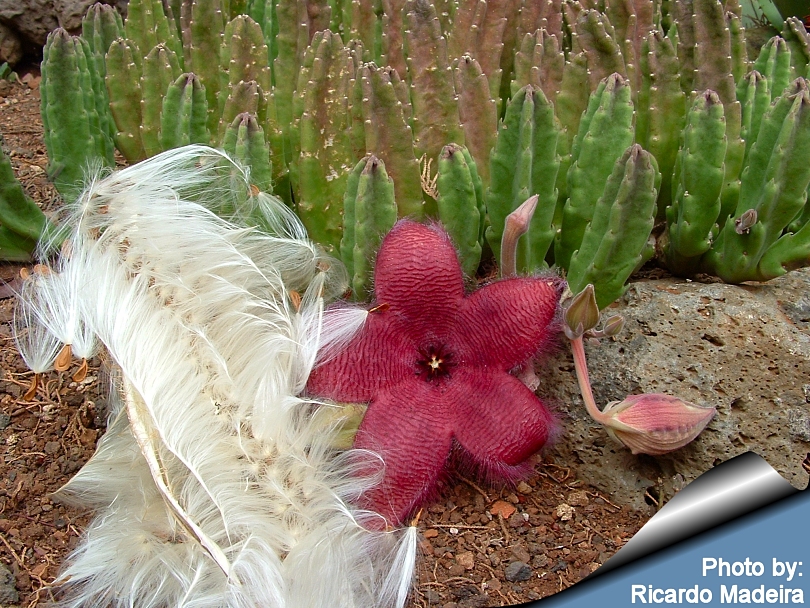
A plant grown in ground (Madeira island) in bloom and with a mature
follicle full of seed.
(Photo Ricardo
- Madeira Island - Portugal)
|
|
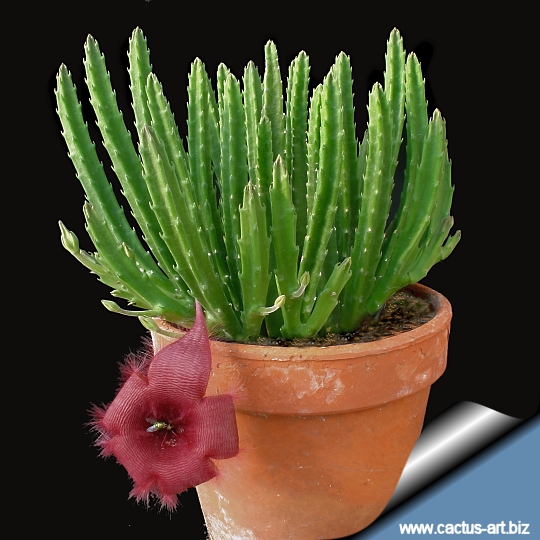
Habit:
Tufted
creeping or
procumbent cactus-like plant that
trail and hang down over the pot with large and showy star-fish
shaped flowers. It can form large clusters up to 50 cm in diameter (or
more). Stapelia grandiflora is a very variable species
with many
hybrids both in the
wild and
in cultivation. This specie meets and intergrade with Stapelia
hirsuta in the little Karoo and the two (quite similar) species
can be separated by its thicker pedicel up to 4-5 mm long.
Stems: About 9-10 cm high. Soft, pale green or reddish and
slightly furrowed with upright hooks along the ridges. Stems are
quadrangular lengthwise, a factor which allows expansion and
contraction to compensate without harm for any excess or shortness of
fluids inside; hence they may appear flat- or sunken-sided according to
the availability of water. This is the "succulence"
and a
storehouse for nutrients, which are crucial to their
survival in harsh,
xeric
habitats.
Leaves: Short lived, rudimentary.
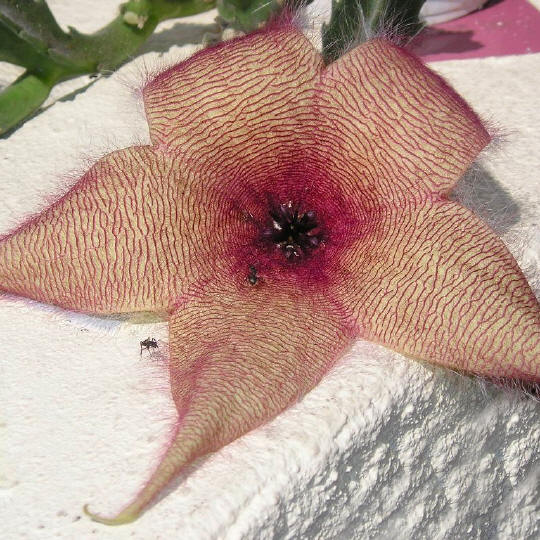
Flower: Blooms are produced from the base on younger shoots,
they are large, flat, star
fish-shaped, orange, dark-red, deep brown-purple to
chocolate, with transverse brow to whitish corrugation and densely
covered by long purplish
hairs at the centre that remember the fur of a dead animal.
Undersides red to greenish.
Corolla width very variable, from 5-15 cm (usually10/12 cm) across
and very deeply
lobed. The moderate carrion
smell of the flowers
attracts
flies which may lay eggs on the flower. Sometimes fly
larvae that have hatched from the eggs can be seen on the flower.
Flowers are smaller than those of Stapelia gigantea. Buds
plump peaked that resemble the domes of a Russian Orthodox church.
Fruit:
Flies pollinate the flowers resulting in the typical twin seed horns
(follicles),
which are decorative in themselves and often don't appear until a year
later.
Blooming season:
Blossoming time: Flowers are intermittently produced throughout the
late
summer and
autumn.
|
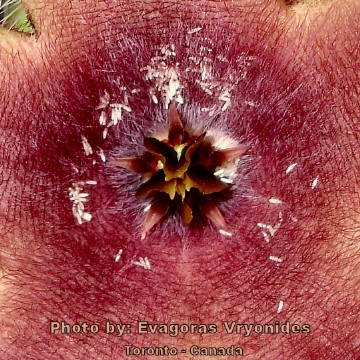
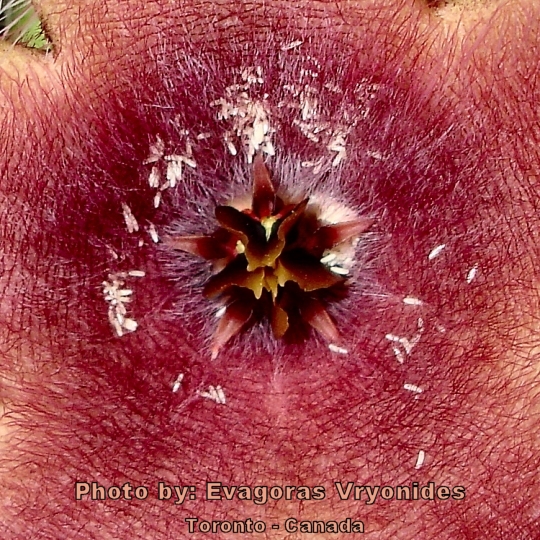
(Photo Evagoras Vryonides - Canada)
The white
corpuscle are
carrion fly eggs. The flies are attracted by the the
flowers that smell like death, and frequently they deposes their eggs on
the furry surface. Flies are wholly deceived and believe that the flower
is the carrion of a dead animal.
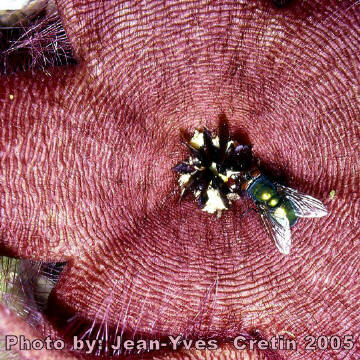
In this
corolla of Stapelia grandiflora a female of "green-bottle fly" (Lucilia
sp.) comes to ovideposit a new packet of eggs... note that a lot of
eggs (the white masses) were deposed before by another flies
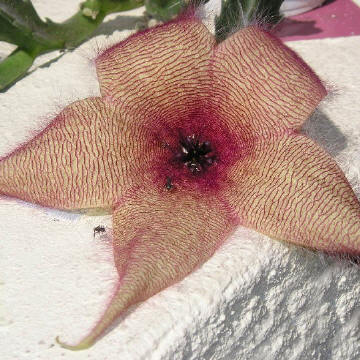
A flowers visited by ant (Myrmecophily
?)
Photo By Viviana Argentina |
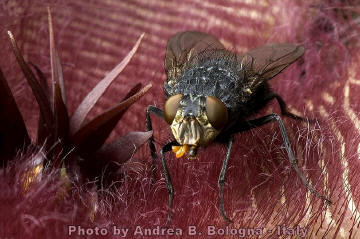
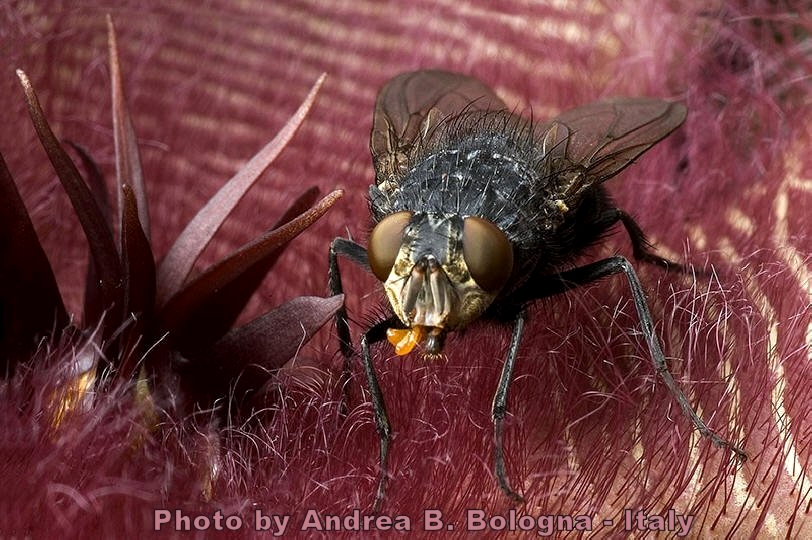
A
pollinating fly on a flower of Stapelia grandiflora
(Photo Andrea B. Italy)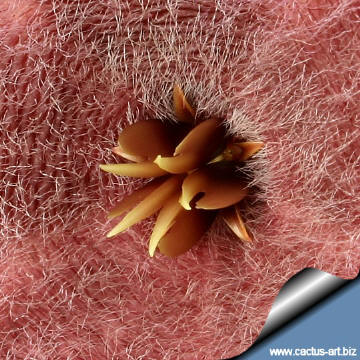
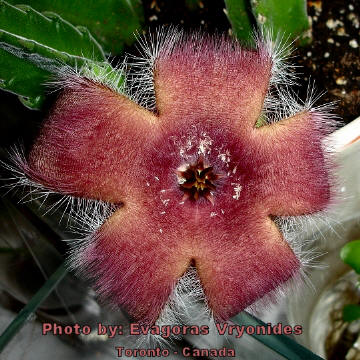
(Photo Evagoras Vryonides - Canada) |
|
|
|


Advertising
|
|
|
|
|
Family:
Asclepiadaceae
(Apocynaceae) (Milkweeds family)
Scientific name: Stapelia grandiflora
Masson
In: Stapel. Nov., 13, t. 11, 1797
Origin: Southern Africa (Northern
cape, Eastern Cape and Free State)
Common names: Carrion Flower, Star Fish Flower, Giant Zulu,
Giant toad plant.
Synonyms:
- Gonostemon grandiflorus
(Masson) P. V. Heath
- Stapelia ambigua
Masson
In: Stapel. 13. t. 12 Hort. Kew. ed. 2. v. 2. p. 86.A
|
|
|
|
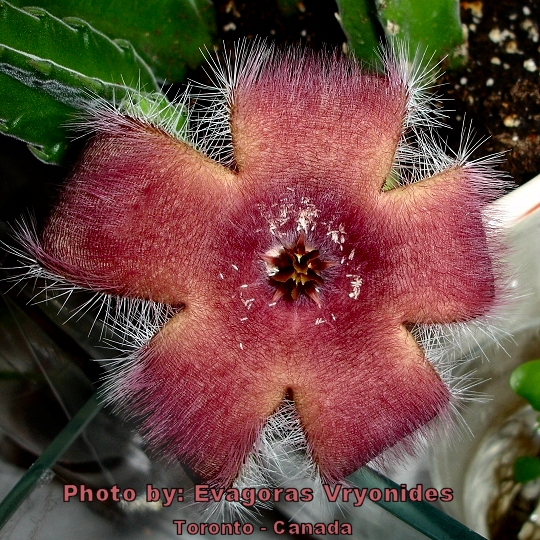
Flowers of this species look very spectacular
(Photo Evagoras Vryonides - Canada)
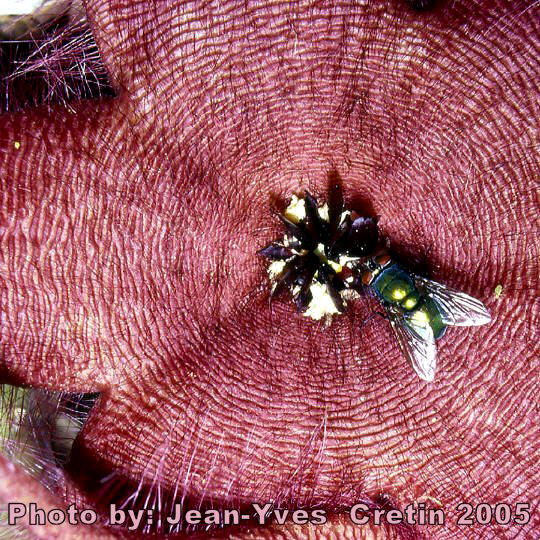
In this
corolla of Stapelia grandiflora a female of "green-bottle fly" (Lucilia
sp.) comes to ovideposit a new packet of eggs... note that a lot of
eggs (the white masses) were deposed before by another flies
[See:
Sapromyophily]
Photo by Jean-Yves
Cretin (France) |
|
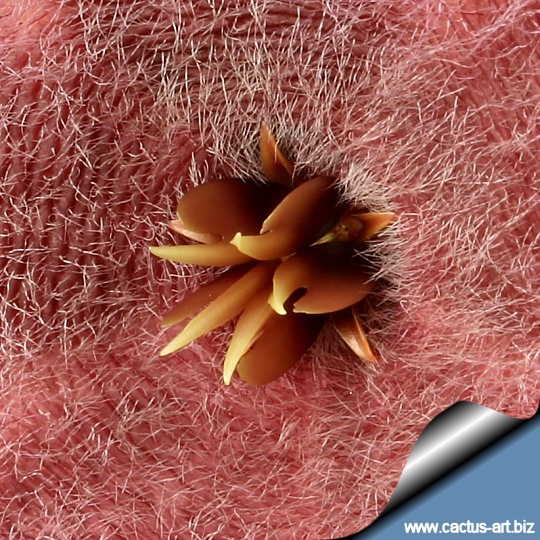
The
gynostegium
Cultivation: Together with
Stapelia gigantea and
Orbea variegata, probably the most widely cultivated of
stapeliads. It is an easy obliging
blooming plant when
mature, they are happy in any average succulent house.
Stapelia require moderately watering through the
growing season but enjoy plenty of water and some
fertiliser in hot
weather, this helps them to
flower freely. Water more sparingly in winter according to
temperatures. But, as with most
asclepiads, it is unwise to leave them wet in cold weather.
Winter care presents no problems at 5°C with plenty of light. Since
roots are quite shallow, use a
cactus mix or add extra
perlite or
pumice to regular soil
potting soil. A gritty, very free-draining
compost is suitable, and
clay pots help the plants to dry out between watering.
Sun Exposure: Partial sun or
light shade
Pest and
diseases: Stapelia species vary in their
susceptibility to
rotting, but are generally fairly easy to grow, especially
if kept
pest-free. They are very
susceptible to stem and root
mealy bugs, and damage from these may well initiate
fungal
attack. If you do have problems with a stem or with basal
rotting, you can reliably isolate the
healthy parts, dry them off, and
re-root them in moist
compost.
Cultural Practices:
Re-pot every 2 years
Propagation:
Easiest with stem
cuttings. Allow cuttings to
dry a day before
planting. Stems must be laid (Not buried) on
gritty
compost and will then
root from the underside of the
stems. It can also be increased from seeds
sowing in
spring in moist,
sandy
peat moss. Barely cover seeds. Seeds
germinate
|
|
|
|
|
The photo in this page has been kindly sent us by
: Andrea B. (Italy), Viviana (Argentina),
Jean-Yves Cretin (France), Evagoras Vryonides (Canada),
Ricardo (Madeira - Portugal), |
|
|
|