|
|
|
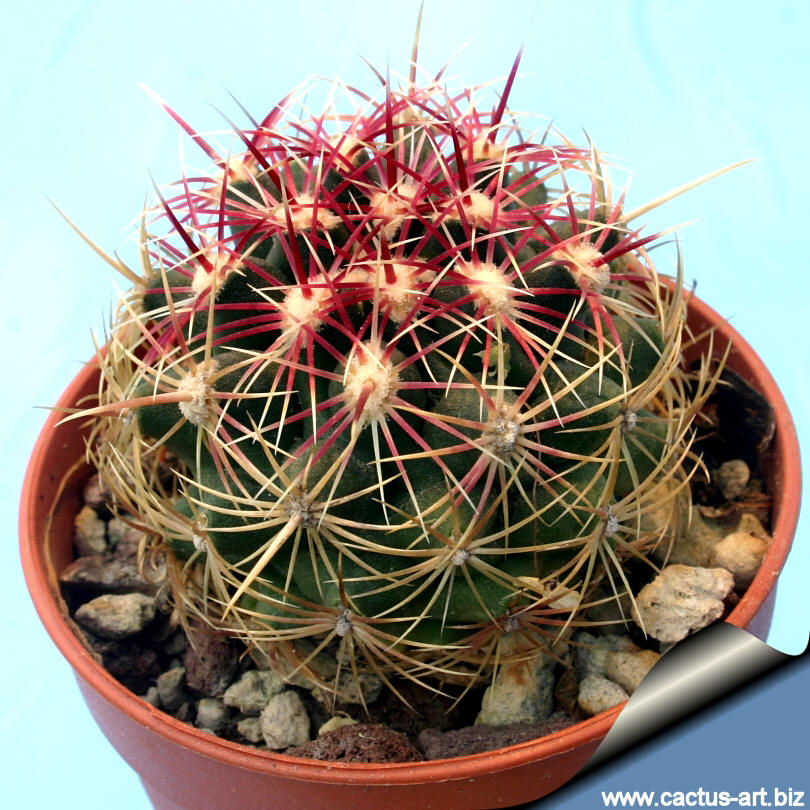
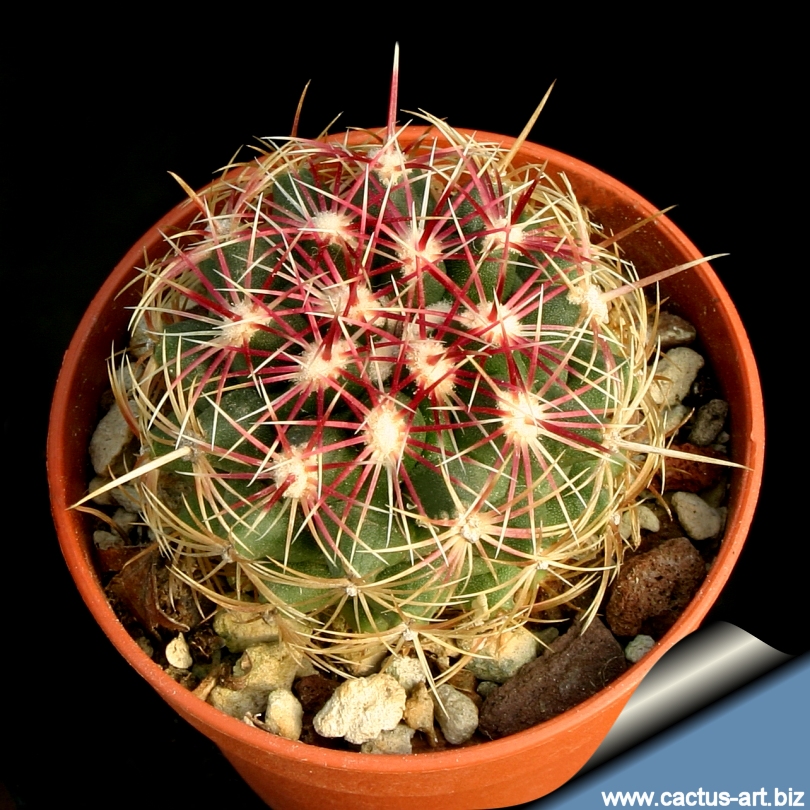
Thelocactus bicolor ssp. flavidispinus
This subspecies is noted for its straw-coloured to red spination;
stem, spines, areoles
and flowers are smaller than the type. |
|
|
Description:Usually solitary.
Stem: 1.5-4.5 cm tall, 2-7 cm wide
Ribs:13, distinct.
Tubercles: Rounded.
Areoles: With glands.
Central spines: 3-4, 15-25 mm long, ochre to reddish, straight,
acicular.
Radial spines: 12-20, 10-15 mm long, ochre to reddish, straight,
acicular.
Flowers: 60-80 mm wide, magenta with a red throat.
Blooming season: Flowers appear exclusively from June through
August.
NOTE: T. bicolor ssp. flavidiflorus has smaller spines and
areoles; spines usually yellow (rarely red, 0-5% in all populations);
stem and flowers are smaller than the type too.
Cultivation: It is a summer
grower species of low maintnence. Water regularly from Spring to
Autumn, but do not overwater, can become too elongated if compost is too
rich. Requires full sun or light shade and careful watering to keep
plant compact with strong coloured spines. Needs good drainage and very
porous potting mix, In Winter, keep dry.
Reproduction: From seed, since the plant rarely produces
plantlets. |
|

 |
|
Advertising
|
|
|
|
Family:
Cactaceae (Cactus
Family)
|
Scientific name:
Thelocactus bicolor ssp.
flavidispinus (Backeb.) N.P. Taylor
Published in: CCI 5: 14 (1998).
Basionym: Thelocactus bicolor var. flavidispinus
Backeb.
Beitr. Sukk.-Kunde Pflege 1941: 6 (1941).
Lectotype: Beitr. Sukk.-Kunde Pflege 1941: 6 (1941).
Conservation status: Listed in
CITES appendix 2
Origin: Endemic to Texas (Marathon Basin of North
Brewster County)
Habitat: Restricted to Caballos Novaculite soil.
Common Names include: Glory of Texas, Straw Spine
Cactus, Texas Pride
Etymology: "flavidispinus" means yellow
spined.
Synonyms:
- Thelocactus flavidispinus Backeb.
Cact. Succ. J. (US) 23: 150 (1951)
- Echinocatus flavidispinus Weniger,
Cacti S. W. 87 (1970) nom. nud.
- Ferocactus bicolor var. flavidispinus N.P. Taylor,
Cact. Succ. J. Gr. Brit. 41: 30 (1979)
|
|
|
|
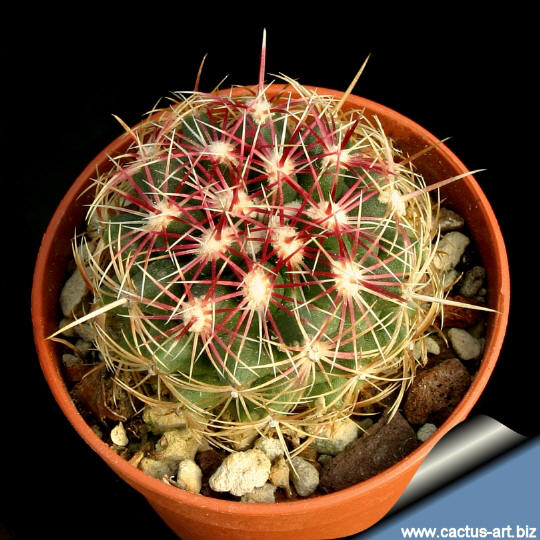
Photo of conspecific taxa,
varieties, forms and of
plants belonging to the Thelocactus
bicolor
complex
(This
Taxon has lots of
synonyms ( like many other
cacti) whit several controversial
varieties and subspecies and comprises a multitude of different
forms, but where each form is linked to others by populations of plants
with intermediate characteristics):
- T.
bicolor var. bicolor (Frost hardiness -7°C )
-
T. bicolor var. bolaensis (Frost hardiness -12°C ) Origin:
Coahuilafrom Sierra Bola, up to 20 cm tall.
-
T. bicolor var. commodus It has been described as
having only one, porrect, central spine, but with a careful
observation it is possible to notice that the upper central spines are
so appressed to the stem that they can be easily mistaken for radials.
- T. bicolor var. ellipticus is
referable to bicolor.
- T. bicolor
var. flavidispinus (Frost hardiness -12°C ) Texas 8cm in
diameter, 5cm tall.
-
T. bicolor var. heterochromus
-
T. bicolor var. pottsii (Referable to bicolor var.
heterochromus).
- T. bicolor var. rhodophthalmus is referable to
bicolor.
-
T. bicolor var. schottii (Frost hardiness -12°C) coming
from the Big Bend area Texas, Chihuahua) characterized by a very long,
papery upper spine.
-
T. bicolor var. schwarzii 1 0° F (-12°C) Tamaulipas
- T. bicolor var. texensis is an invalid name
for a Texas form.
- T. bicolor var. tricolor (Frost hardiness -7°C ) A
form with bright red spines. Plants with these characters can be found
around Saltillo, Coahuila.
- T. bicolor var. zwakii, It is not sufficiently
distinct to deserve a subspecies rank.
Cultivars:
Thelocactus bicolor cv. INERMIS |
|


 Cultivation
and Mail Sale
Cultivation
and Mail Sale