|
|
|

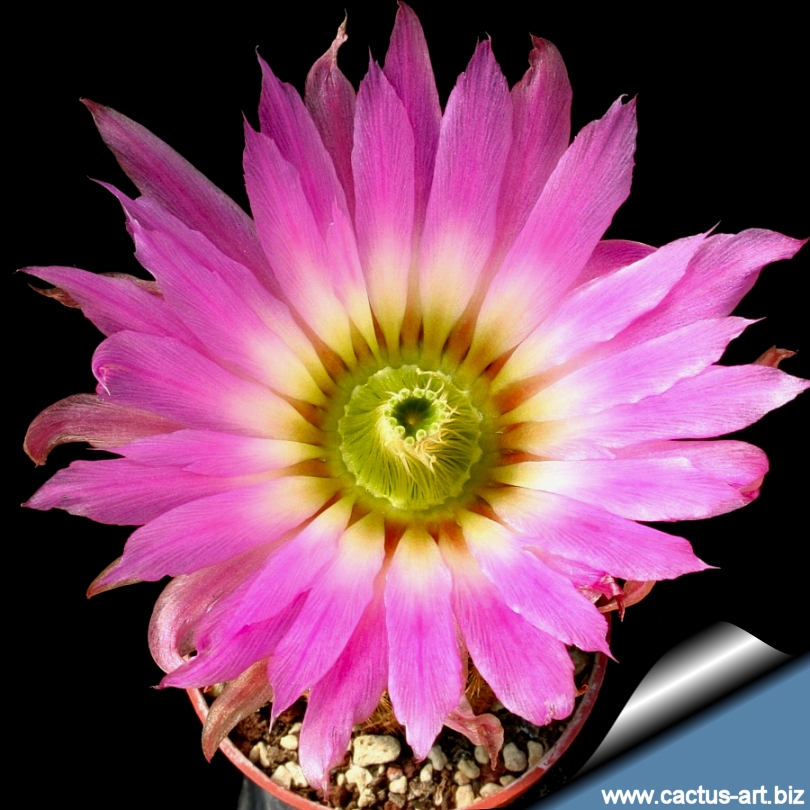
E. pectinatus
As potted plant it is enormously popular for its easy culture and
free flowering.
|
|
Description:
It commonly remains single, but old plants sometime branch and form
several heads.
Stems: Cylindrical stems 10-20 cm tall 3-6 cm in diameter almost
hidden by the short interlocking spines.
Ribs: (12-)20-23 obtuse, usually straight.
Areoles:
Approximate, but not touching one another, about 3 mm long, oval, young areoles with short white hair.
Central spines: Not present or 1 to 6 and very short, more or
less
porrect.
Radial spines: 16 to 30 white or pinkish 5-10 mm long, spreading
widely, pectinate, and intertwining with those of the other areoles often in coloured bands.
Flowers: Funnel-shaped, diurnal, intense pink (but also magenta, lavender...Or...Yellow
to near-whitish) with a white-greenish base, 6-8 cm long , petals quite
long and pointed, areoles very spiny with white hairs on the floral tube.
Stamen usually cream coloured.
Fruit: Spiny, greenish-purple, becoming naked, 2-3 cm in
diameter. Gooseberry-like rich in sugar and said to be very delicious.
|
 |

|
|
Photo of conspecific taxa,
varieties, forms and cultivars of Echinpsis pectinatus:
(This taxon has lots of synonyms (like
most Echinocereusi ) whit several controversial varieties and subspecies):
Advertising
|
|
|
|
|
Family:
Cactaceae (Cactus
Family) |
|
Scientific name:
Echinocereus pectinatus
(Scheidweiler) Engelmann 1848
Origin:
Southwestern US, northern Mexico
Conservation status: Listed in
CITES appendix 2.
Synonyms:
- Echinocactus pectinatus Scheidweiler 1838 TL:
Mexico, San Luis Potosi, Villa del Peñasco, Galeotti (?)
- Echinopsis pectinata (Scheidweiler) Fennel 1843
- Cereus pectinatus (Scheidweiler) Engelmann 1849
- Echinocereus pectinatus var. saltilloenis
- Echinocactus pectiniferus Lemaire 1839is usually
considered a synonym of this species.
Note: Echinocereus cernosus Fric 1929:24 nom. nud.
is listed by Backeberg as a synonym of this species.
Common Name: Comb Hedgehog, Texas rainbow
cactus, Lace cactus
Etymology: Latin for comblike, for the spines
|
|
|
|

This is a particularly fine-flowering species due to the satiny sheen of
the petals, which make them glow in sun light.
|
|
Cultivation: In culture E. pectinatus is without
problems and regularly shows its beautiful flowers if we provide
an adequate winter rest period. It is sensitive to
overwatering (rot prone) needs good drainage, Keep drier and cool in
winter. Need full sun; Very cold resistant
hardy to -10° C or less for short periods of time.
Propagation: Seeds or cutting (if available) |
|


|
|


 Cultivation and
Mail Sale
Cultivation and
Mail Sale