|
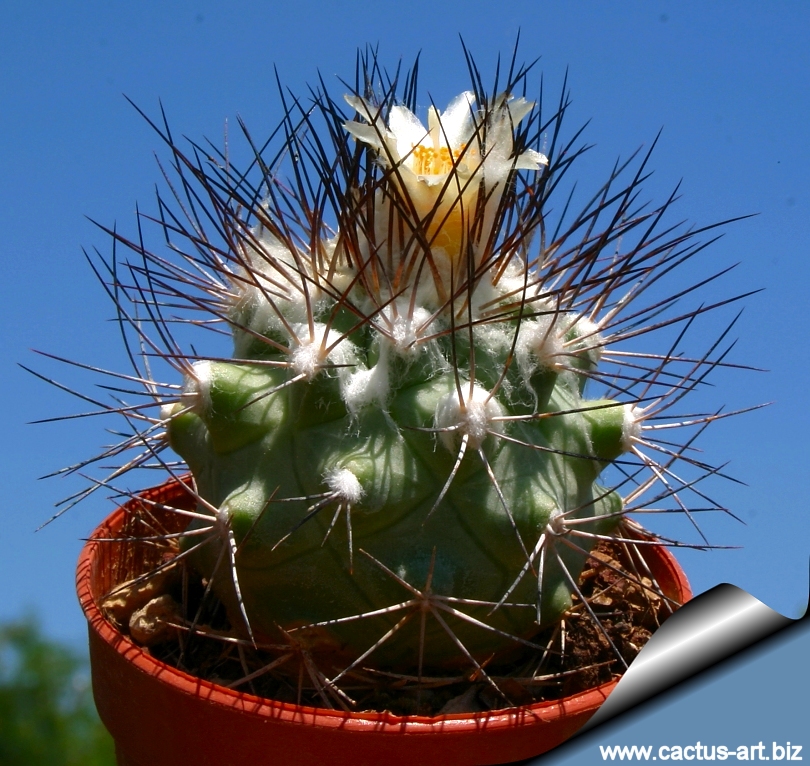
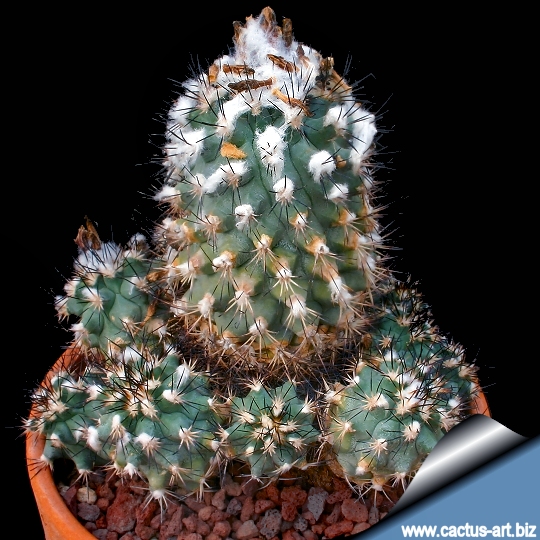
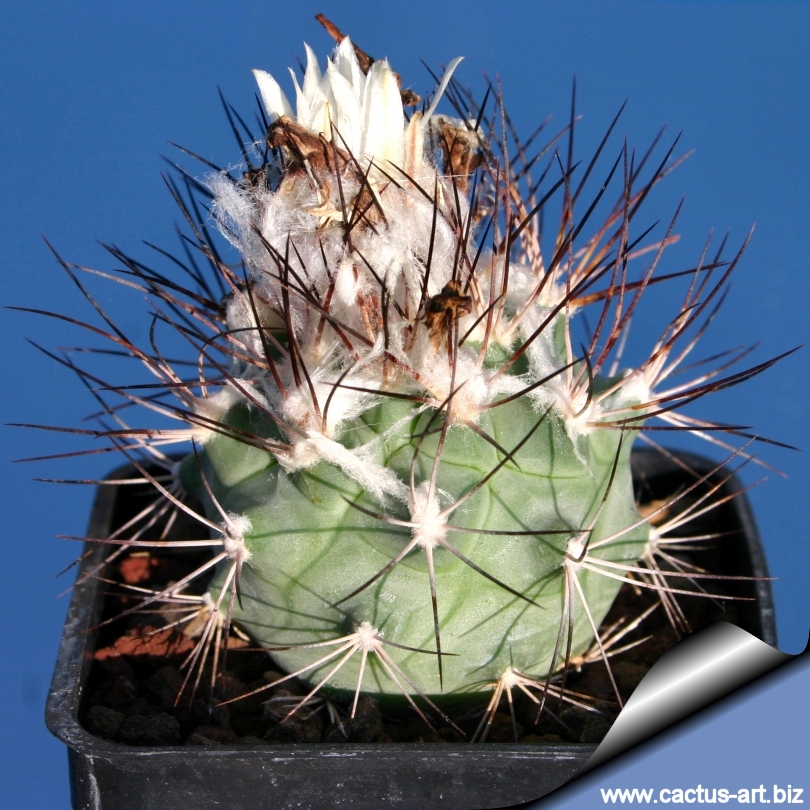
Description: Usually solitary occasionally very clustering, globose
to slightly cylindrical cactus
Stem: Bluish to greyish to yellow-green, older parts with whitish
markings, up to 7 cm tall , 4,5-5 cm in diameter; apex barely sunken,
with black spines tips emerging from a dense white woolly coat.
Root: Swollen bundled.
Tubercles: Loosely ordered, angular, conical-pyramidal , younger
with steeper lateral surfaces, the older somewhat flattened out, rising
from a wide hexagonal base, 3-6 mm long;
Areoles: Elliptical up to 2 mm long, with abundant ephemeral
wool, later only with a tuft of wool in the short furrow, soon
completely bald and corky.
Radial spines: 6 or 7, up to 2 cm long, awl-shaped, straight or
with the tip curved, white in the basal portion and black at the tips,
becoming completely whitish as they ages. Old spines dirty dark grey
brown and packed together.
Cental spines: Usually absent
but sometime 1 of the same colour and size of the radials.
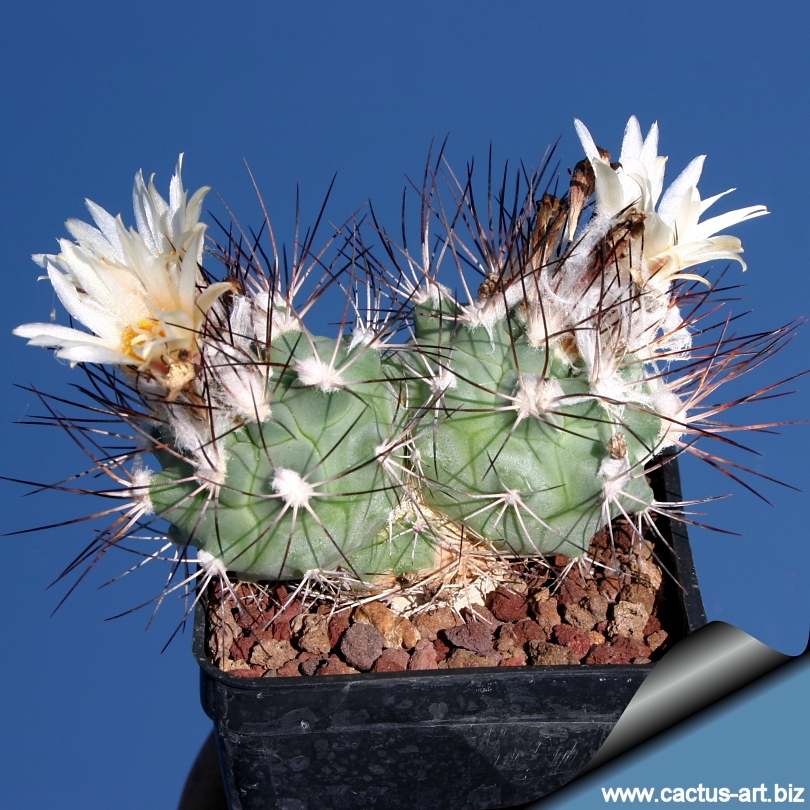
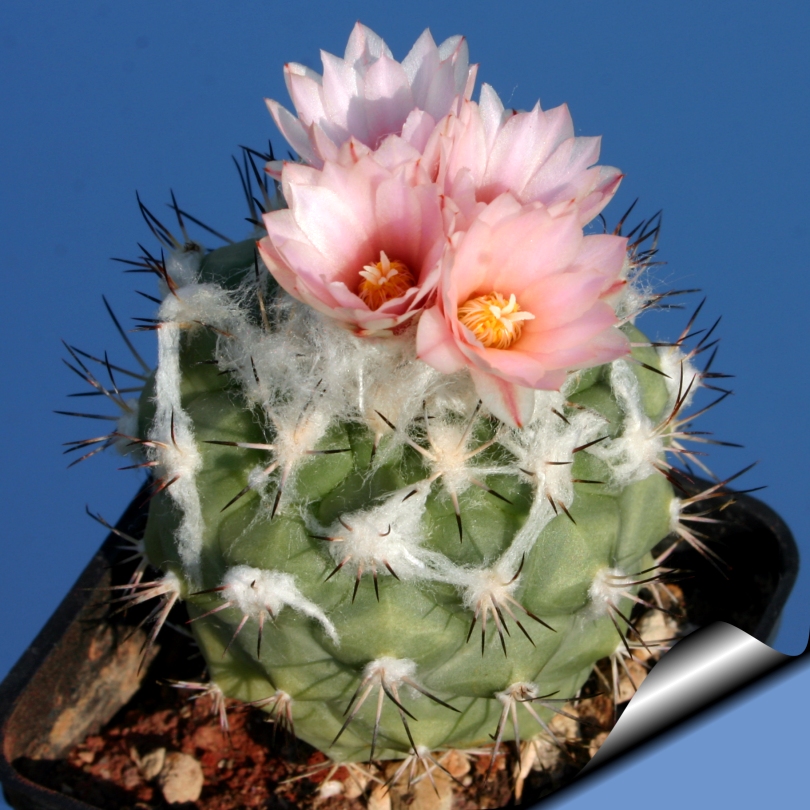
Flower: Creamy-white with darker midribs, from the apical wool,
individually or few, funnel-shaped; 18-20 mm long, 20-25 mm in diameter.
The perianth tube with a ring-shaped constriction. Perianth tube approx.
5 mm long, expanding above, lower part without scales, pale
olive-brownish. Scales only at the end, oblong, approx. 2-8 mm long,
merging into the outer perianth segments, pale brownish green with light
edge, reddish median, at the end with a somewhat curved, russet coarse
hair-like tip, filaments white, anthers chrome yellow. Style white,
approx. 12 mm long. Stigma lobes 5-6, overstanding the stamens, approx.
2 mm long, white, spreading, very papillose, almost hairy.
Fruit: Green dehiscing longitudinally.
Seeds: Dull-Black,
kidney shaped, 1-1.2 mm long.
|


 Cultivation and
Mail Sale
Cultivation and
Mail Sale