|
|
|
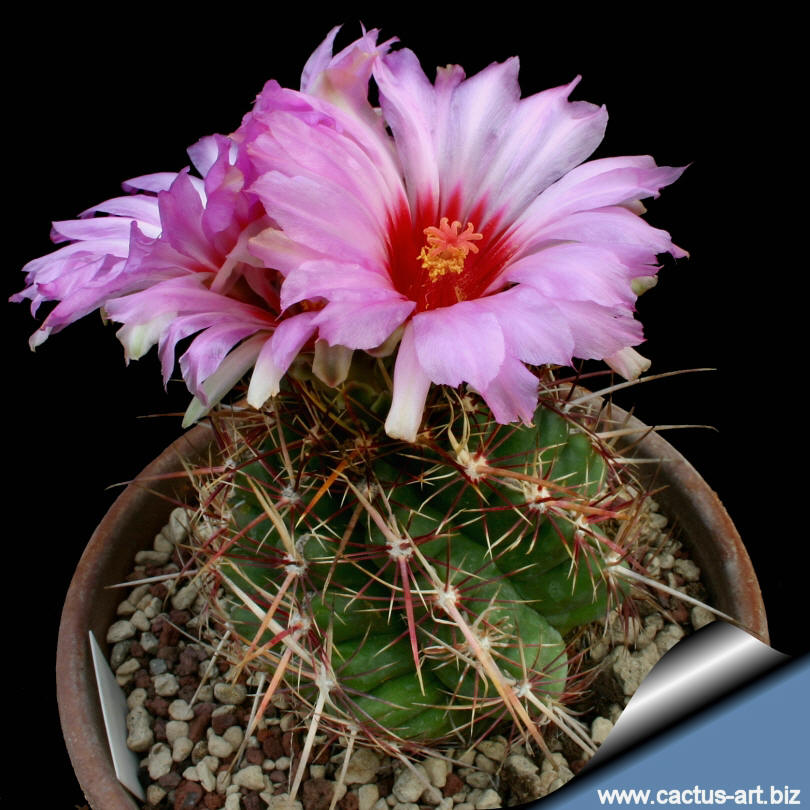
The flowers are large silky pink with a red throat. |
|
|
Description: Usually solitary.
Stem: Large, globular, low-growing, green, reach hardly 15 cm in
diameter and get 10-15 cm tall. Epidermis - bluish-sulphur- green
that became almost red-brown during the winter rest when the plants are
dry.
Tubercles: Rounded that form 8-11 (usually 9) distinct ribs.
Areoles: Round, on the outer side of tubercle bear semicircular
heavy cut.
Spines: 7-11 (-19), powerful, very different in length, thickness
and colour.
Central spines: 1-2 (or more) bent back and newly bent to the
body the upper one is flattened, red- white colored, the spines produced
in spring are brighter and redder while the one produced the hot period
of year are paler, some plants have very short spines, whose central
prickle has a length of only of 1,5 cm, but there are plants with 5,5 cm
long spines. The name "heterochromus" (= many-colored) indicates patch
effect of prickles, but it can be also applied to the variable colours
of spines in different plants.
Radial spines: 9-11 (-18) 1,5-3 cm long, yellowish strong,
awl-shaped, usually bent downward.
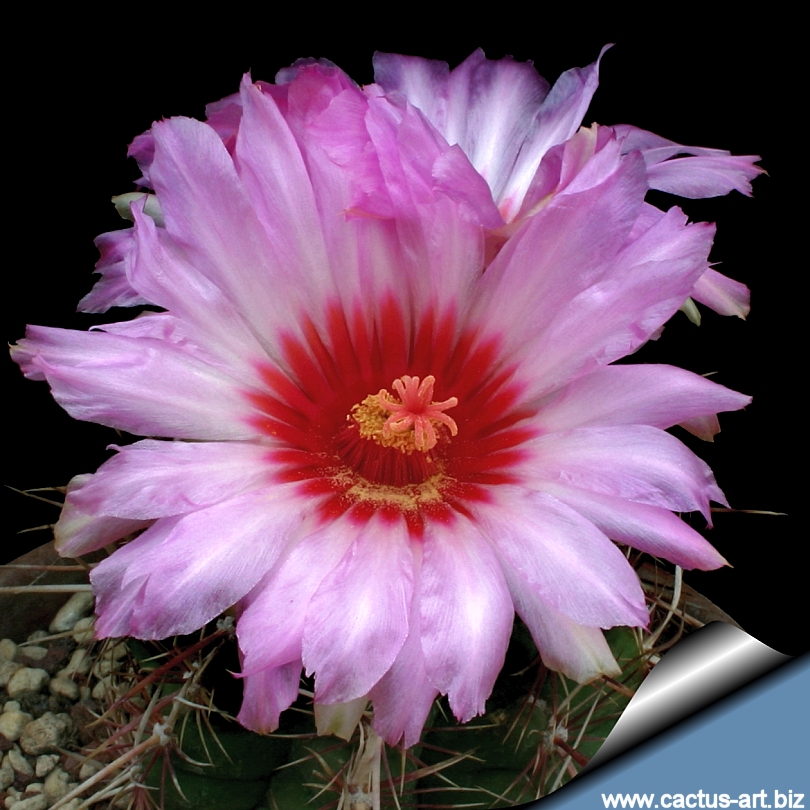
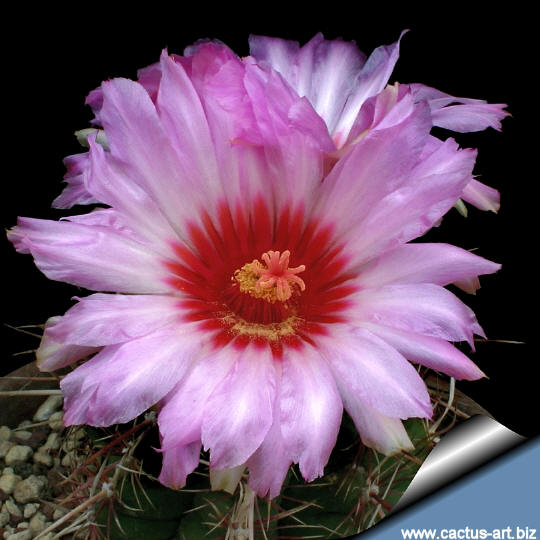
Flowers: Imposing 8-10 cm in diameter pink-violet lobes with a
dark red throat and yellowish orange anthers.
Blooming season: Flowers appear exclusively from June through
August.
|
|
Cultivation: It is a summer
grower species easy to cultivate. Water regularly from Spring to Autumn,
but do not overwater, can become too elongated if compost is too rich.
Requires full sun or light shade and careful watering to keep plant
compact with strong coloured spines. Needs good drainage and very porous
potting mix, In Winter, keep dry.
Reproduction: From seed, since the plant rarely produces plantlets.
This is one of most beautiful Thelocactus. But,
unfortunately, this plant is supplied only, rarely, sometimes by the
name
Thelocactus heterochromus.

 |
|
Advertising
|
|
|
|
Family:
Cactaceae (Cactus
Family)
|
|
Scientific name:
Thelocactus bicolor
var. pottsii (Salm-Dyck) Backeberg 1962
Conservation status: Listed in
CITES appendix 2
Origin:
Northeastern Mexico (Chiuaua and coahuila) Like many cactus forms of
this dry, hot region of Mexico, plants are strongly variable; therefore
a precise description is impossible.
Synonyms:
- Echinocactus pottsii Salm-Dick
In: "Allgemeinen Gartenzeitung 1850
- Thelocactus pottsii (Salm-Dyck) Britton & Rose 1923
- Echinocactus heterochromus F. A. C. Weber
In: " French garden lexicon " 1896
- Thelocactus heterochromus (F. A. C. Weber) van
Oosten 1940
- Echinocactus bicolor [var.] pottsii Salm-Dyck 1850
- Ferocactus heterochromus (F. A. C. Weber) N. P.
Taylor 1979
|
|
|
|
Photo of conspecific taxa,
varieties, forms and of
plants belonging to the Thelocactus
bicolor
complex
(This
Taxon has lots of
synonyms ( like many other
cacti) whit several controversial
varieties and subspecies and comprises a multitude of different
forms, but where each form is linked to others by populations of plants
with intermediate characteristics):
- T.
bicolor var. bicolor (Frost hardiness -7°C )
-
T. bicolor var. bolaensis (Frost hardiness -12°C ) Origin:
Coahuilafrom Sierra Bola, up to 20 cm tall.
-
T. bicolor var. commodus It has been described as
having only one, porrect, central spine, but with a careful
observation it is possible to notice that the upper central spines are
so appressed to the stem that they can be easily mistaken for radials.
- T. bicolor var. ellipticus is
referable to bicolor.
-
T. bicolor var. flavidispinus (Frost hardiness -12°C
) Texas 8cm in diameter, 5cm tall.
-
T. bicolor var. heterochromus
- T. bicolor var.
pottsii (Referable to bicolor var. heterochromus).
- T. bicolor var. rhodophthalmus is referable to
bicolor.
-
T. bicolor var. schottii (Frost hardiness -12°C) coming
from the Big Bend area Texas, Chihuahua) characterized by a very long,
papery upper spine.
-
T. bicolor var. schwarzii 1 0° F (-12°C) Tamaulipas
- T. bicolor var. texensis is an invalid name
for a Texas form.
- T. bicolor var. tricolor (Frost hardiness -7°C ) A
form with bright red spines. Plants with these characters can be found
around Saltillo, Coahuila.
- T. bicolor var. zwakii, It is not sufficiently
distinct to deserve a subspecies rank.
Cultivars:
Thelocactus bicolor cv. INERMIS |
|


 Cultivation
and Mail Sale
Cultivation
and Mail Sale