|
|
|
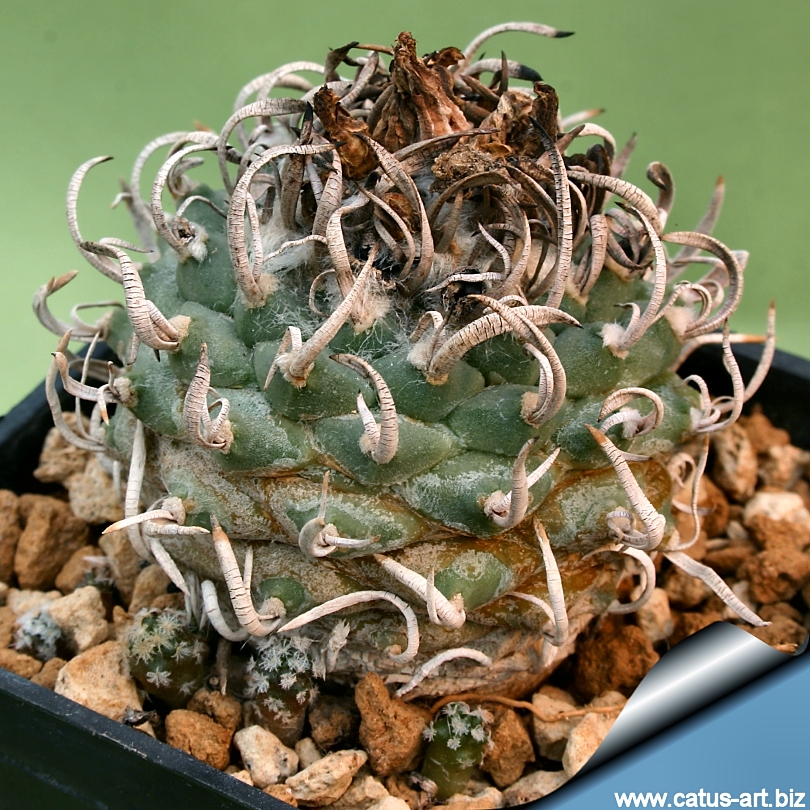
T. schmiedickeanus ssp. schwarzii has a has
typically a pale green epidermis, angled tubercles rising above the
general level of the plant body .
|
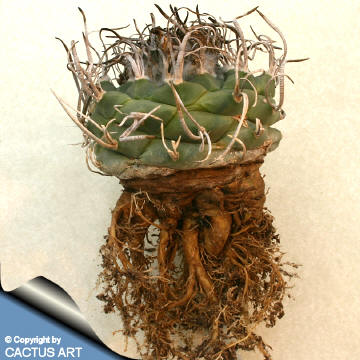 |
Description: Solitary or slowly clumping , small, dichotomy also
observed,
Stem: Flattened semi-globose; turbinate, pale green globose stem,
with a further 30 mm underground, 2 cm tall, 3.5-5 cm in diameter, with
minute dots of short white hairs, like down, watery sap;
Parastichy number: 5 and 8
Areoles: Oval, woolly, at top of plant, quickly disappear.
Tubercles: Flattened 4-angled (diamond shaped) broad and stumpy,
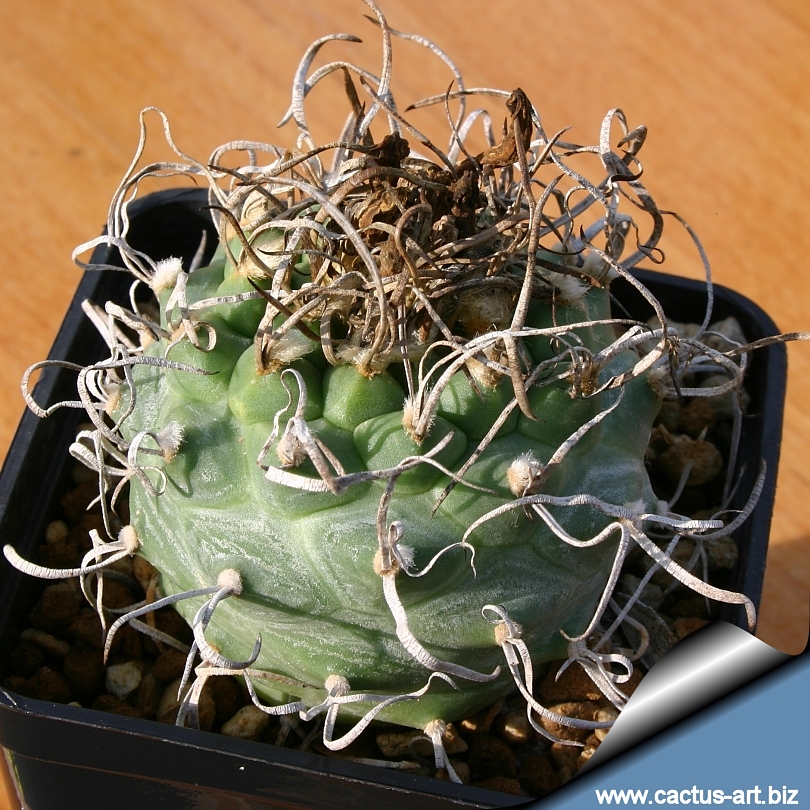
Spines: 1 to 3 spongy yellowish brown or whitish horn coloured,
the lower one longer, up to 2 cm, the 2 side spine approximately 4-5 mm,
often missing, still shorter, flattened below, curved towards the apex
and often contorted grey, corky, rather soft, with transverse fissures.
The spines are bunched at plant apex and persistent only on the upper
body, below they fall off and the body and tubercles are corky and bare.
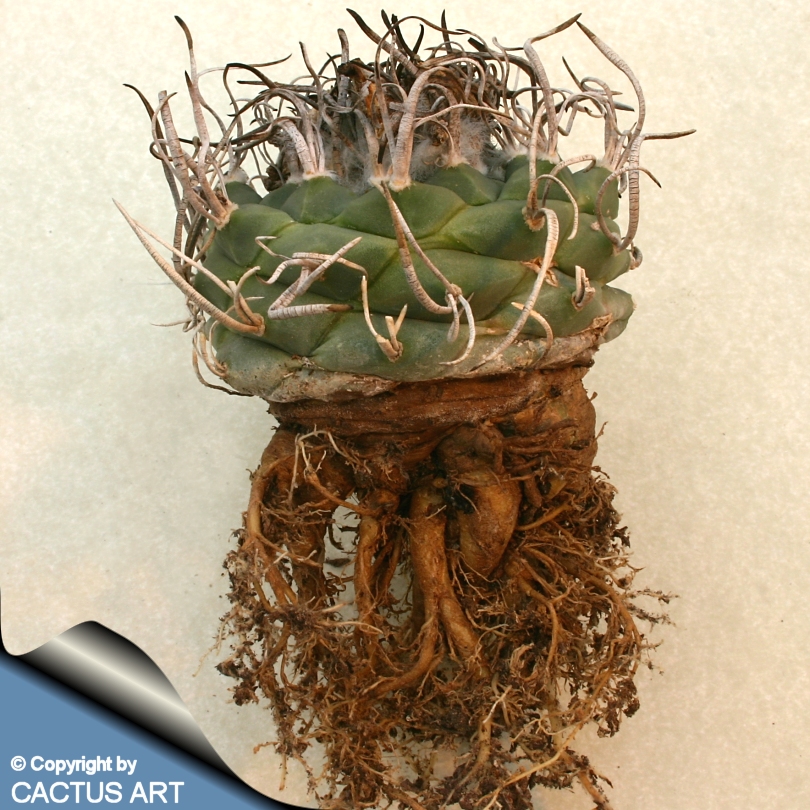
Root: Tap root, nearly shaped like a drawn molar tooth, with mass
of fibrous roots.
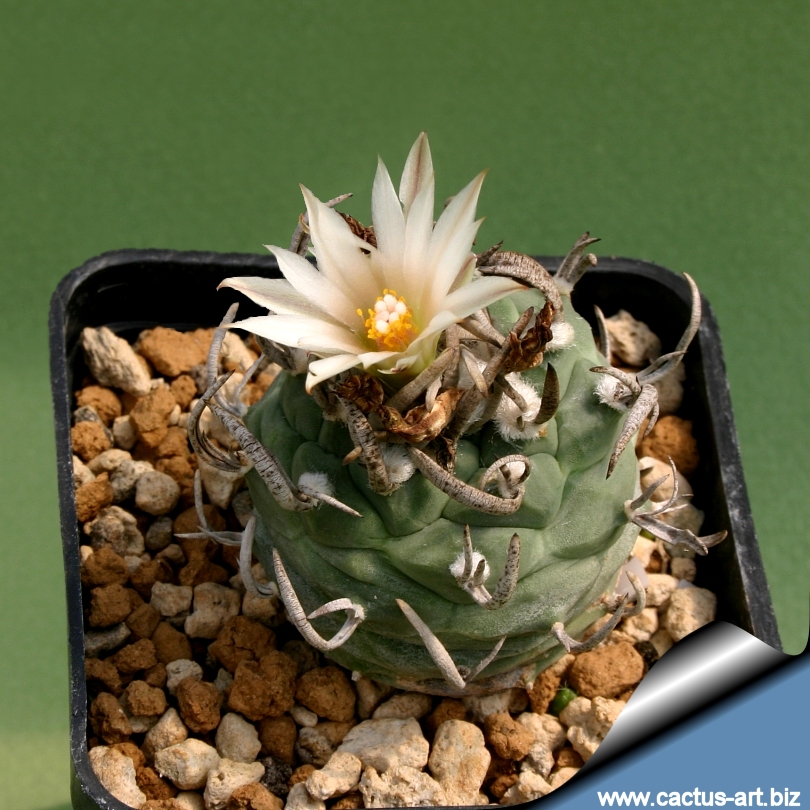
Flowers: Apical short tubed, campanulate, 20-30 mm long,
30-40 mm wide, sepals lanceolate, margins entire, whitish or pink.
Flowering season: July to September |
|
|
|
NOTE: For a long time it was thought that
T.
smiedicheanus var. polaskii was a synonym of this taxa.. The easiest ways
to distinguish between them are schwarzii has a pale green epidermis,
angled tubercles and white stigma, whereas polaskii has a brownish
epidermis, flat, rounded and pink stigma.
The dimensions given for the size of the flower are too large. In my
experience each dimension needs to be reduced by at least 10 mm.
Photo of conspecific taxa, varieties, forms and
cultivars of plants belonging to the Turbinicarpus schmiedicheanus
aggregate: (This taxon
has lots of synonyms, with
several controversial varieties and subspecies):
|
|


Advertising
|
|
|
|
|
Family:
Cactaceae (Cactus
Family)
Scientific Name:
Turbinicarpus schmiedickeanus subsp. schwarzii (Shurly)
N.P.Taylor 1998
Basionim: Strombocactus schwarzii Shurly
Published in: Cact. Succ. J. GB 10(4): 93-94 (1948)
Etymology: Discovered by Fritz Schwarz and named, at his
request, in his honour.
|
|
Distribution: Origin: Mexico (Eastern San Luis Potosí: La
Bonita)
Habitat: Grows in heavy black earth among small green plants
or grass and mostly under shrubs. |
Conservation status: Listed in
CITES Appendix I
|
Synonyms:
- Turbinicarpus schwarzii (Shurly) Backeb. 1951
- Toumeya macrochele var. schwarzii (Shurly) Kladiwa
1975
- Toumeya schwarzii
- Turbinicarpus macrochele ssp. schwarzii
- Turbinicarpus schmiedickeanus var. schwarzii (Shurly)
Glass & Foster 1977
- Pediocactus schmiedickeanus subsp. schwarzii (Shurly)
Halda 1998
- Turbinicarpus schmiedickeanus var. schwarzii
- Turbinicarpus schmiedickeanus ssp. klinkerianus fa.
schwarzii
- Neolloydia schmiedickeana var. schwarzii
- Echinocactus schmiedickeanus
|
|
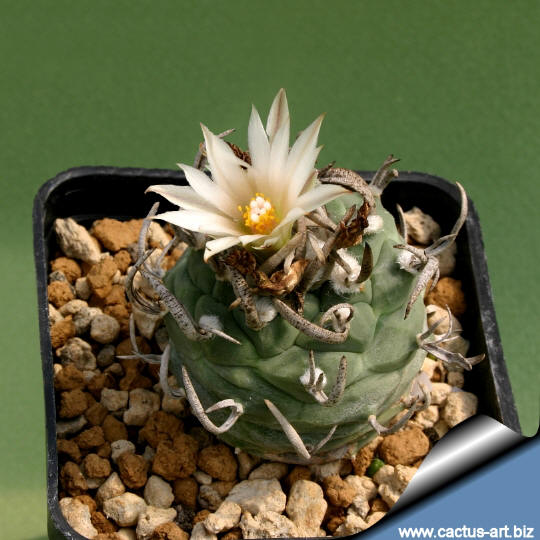
The stigma in this species is white
|
|
|
|
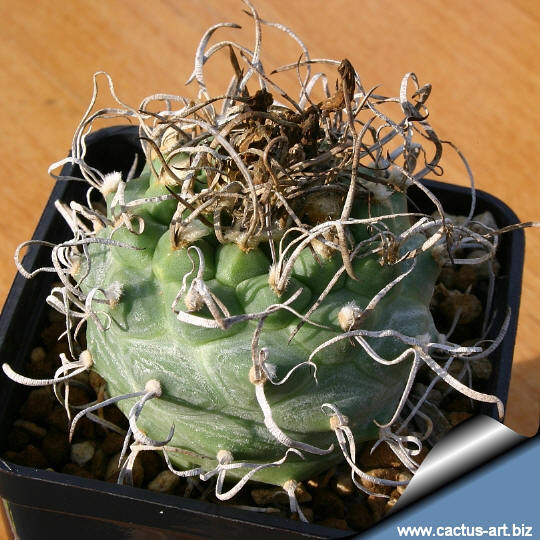
Turbinicarpus schwarzii (Guadalcazar)
Cultivation: It’s a fairly easy species to cultivate. Need a very
well drained soil. Requires strong sun to part sun to develop good
spinal growth and waterings should be rather infrequent to keep the
plant compact and not to become excessively elongated and unnatural in
appearance. keep dry in winter or when night temperatures remain
below 10° C, it is hardy to -4°C for a short period. Assure a good
ventilation.
|
|


 Cultivation
and Mail Sale
Cultivation
and Mail Sale