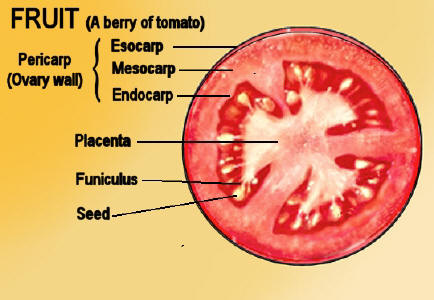
A fruit is the
ripenedovary
or ovaries of a flowering
plant, together with accessory parts consolidated with it,
containing the seeds and occurring in
a wide variety of forms
and to some extent assists in the
dissemination of the seeds.
Typically a fruit start to develop after that an
ovule is
fertilized as a result of the
process of pollination, the
ovary begins to enlarge. The
petals of the flower drop and the
ovule develops into a seed.
Fruit and Seed dispersal:
Dispersal is the natural process of dispersing of plant fruit and seeds
over a wide area. There are six common means of dispersal:
Some species of climbing
plants develop holdfast roots which help to support the vines on
trees, walls, and rocks. By forcing their way into minute pores and
crevices, they hold the plant firmly in place.
Climbing plants, like the poison ivy (Toxicodendron
radicans), Boston ivy (Parthenocissus
tricuspidata), and trumpet creeper (Campsis
radicans), develop holdfast roots which help to
support the vines on trees, walls, and rocks. By forcing their
way into minute pores and crevices, they hold the plant firmly
in place. Usually the Holdfast roots die at the end of the first
season, but in some species they are perennial. In the tropics
some of the large climbing plants have hold-fast roots by which
they attach themselves, and long, cord-like roots that extend
downward through the air and may lengthen and branch for several
years until they strike the soil and become absorbent roots.
Major references and further lectures:
1) E. N. Transeau “General Botany” Discovery Publishing House,
1994