Synonym:
Shrinkage, Contraction Transitive and intransitive verb:
To retract (past
and past participle:
retracted, present participle:
retracting, 3rd person present
singular: retracts) Derived forms:
Retraction, Retractility, Retractile
TO RETRACT (verb): To
move, or move something, back inside: to shrink something
backwards from an extended position, to pull inward or towards a
centre; or be drawn in.
RETRACTION (Noun): The
act of retracting something, or the condition of being retracted.
RETRACTILITY (Noun):
The capability of something of retracting.
RETRACTILE (Adjective):
Able of being retracted
[ From Latin "re" to
revoke, and "tractum" (past participle of
"retrahere" to draw back) = pulled; hence, to pull
something back ]
Several succulents during
seasonaldormancy periods –
often throughout most of the year - retract just below the
soil surface often with
only the summit protruding above making the plants almost
impossible to locate during hot,
dry periods. Besides trunks
and stems of
columnar species are often
ribbed (accordion like), and
can expand and retract
with the amount of water they
contain.
For example the
columnartrunk of a Saguaro (Carnegia
gigantea) has ribs which
enable the plant to swell and shrink like an accordion depending
on rains. A
mature saguaro may
soak up 50 litres
of water during a
rainstorm, only gradually
transpiring its
supply over long periods of
drought. (See: Table 1)
Same leaf succulents
like Haworthias have
long, fleshy, retractile
(contractile) roots. In
the cool wet seasons, these roots serve as a
water store, much
like the
caudiciforms. In the dry hot summers, these roots serve two
functions: they return
moisture to the body of the
plant and, while doing so, they shrink, pulling the plant deeper
into the soil to protect the
plant from sun and
heat.
Physiology of retraction
(Contraction) of cactus
stems.
Cactus cortex is
divided into an inner water-storing
region and an outer
photosynthetic layer. More than
cortical bundles is
needed to move water from the
storage region to the
chlorophyllous region: water-storing cells should give up water
more easily than do other cells. The
selective advantage of storing
water is not just that it keeps water-storage cells
alive but rather
that the water can be made available to cells of the photosynthetic
palisadecortex, the
apical and
axillary buds, any
flower buds or
developing fruits and so on. Consequently,
water-storage cells
should have thin, flexible walls that can contract or shrink readily
such that the cell’s volume diminishes as water is transferred out.
On the other hand, the cells that need the water should be more
resistant to shrinkage: if all cell walls were equally
flexible, all
parts of the plant would suffer
water stress equally, but that is
not adaptive. Instead,
water-storage tissues should give up water so
easily that the more active cells do not experience
water stress
unless drought is extremely prolonged. In all
cacti,
cell walls of
the inner cortex are especially thin and
flexible, but in many
cacti there is an additional modification: the walls are folded or
undulate, even when young and recently produced by the
shoot apical
meristem. As the amount of succulent tissue increases in a
stem, so
does the potential for large changes in volume: the plant will swell
greatly after a rain and shrink during
drought The
epidermis and
hypodermis must accommodate this, but whereas
young, growing
dermal
tissues are extremely
extensible,
mature ones are not: the total
surface area of a region of
mature stem tends to be constant. Many
succulent stems have contiguous ribs or
tubercles that can widen or
shrink at the base whenever the stem swells or contracts When
dry,
the stem has lost volume and the ribs are narrow; when
hydrated, the
stem is swollen and its ribs are broad. Thus, volume
cycles, while
surface area remains constant. Ribbed stems occur in
Asclepiadaceae,
Cactaceae,
Euphorbiaceae, and Vitaceae as well as other families.
(See: Table 1)
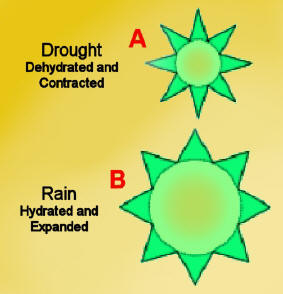
Table 1: During a
drought, a
ribbed or
tubercledstem is
dehydrated and has a
small volume (A), but after a
rain it quickly
rehydrate
and volume increase (B) Although the
surface area is unchanged.
Typically, ribs or tubercles touch each other at their
base and
the stem axis has no surface other than rib surface when swollen.
Some species of climbing
plants develop holdfast roots which help to support the vines on
trees, walls, and rocks. By forcing their way into minute pores and
crevices, they hold the plant firmly in place.
Climbing plants, like the poison ivy (Toxicodendron
radicans), Boston ivy (Parthenocissus
tricuspidata), and trumpet creeper (Campsis
radicans), develop holdfast roots which help to
support the vines on trees, walls, and rocks. By forcing their
way into minute pores and crevices, they hold the plant firmly
in place. Usually the Holdfast roots die at the end of the first
season, but in some species they are perennial. In the tropics
some of the large climbing plants have hold-fast roots by which
they attach themselves, and long, cord-like roots that extend
downward through the air and may lengthen and branch for several
years until they strike the soil and become absorbent roots.
Major references and further lectures:
1) E. N. Transeau “General Botany” Discovery Publishing House,
1994